Talk with our engineers by joining the new Onehouse community Slack!
TL;DR
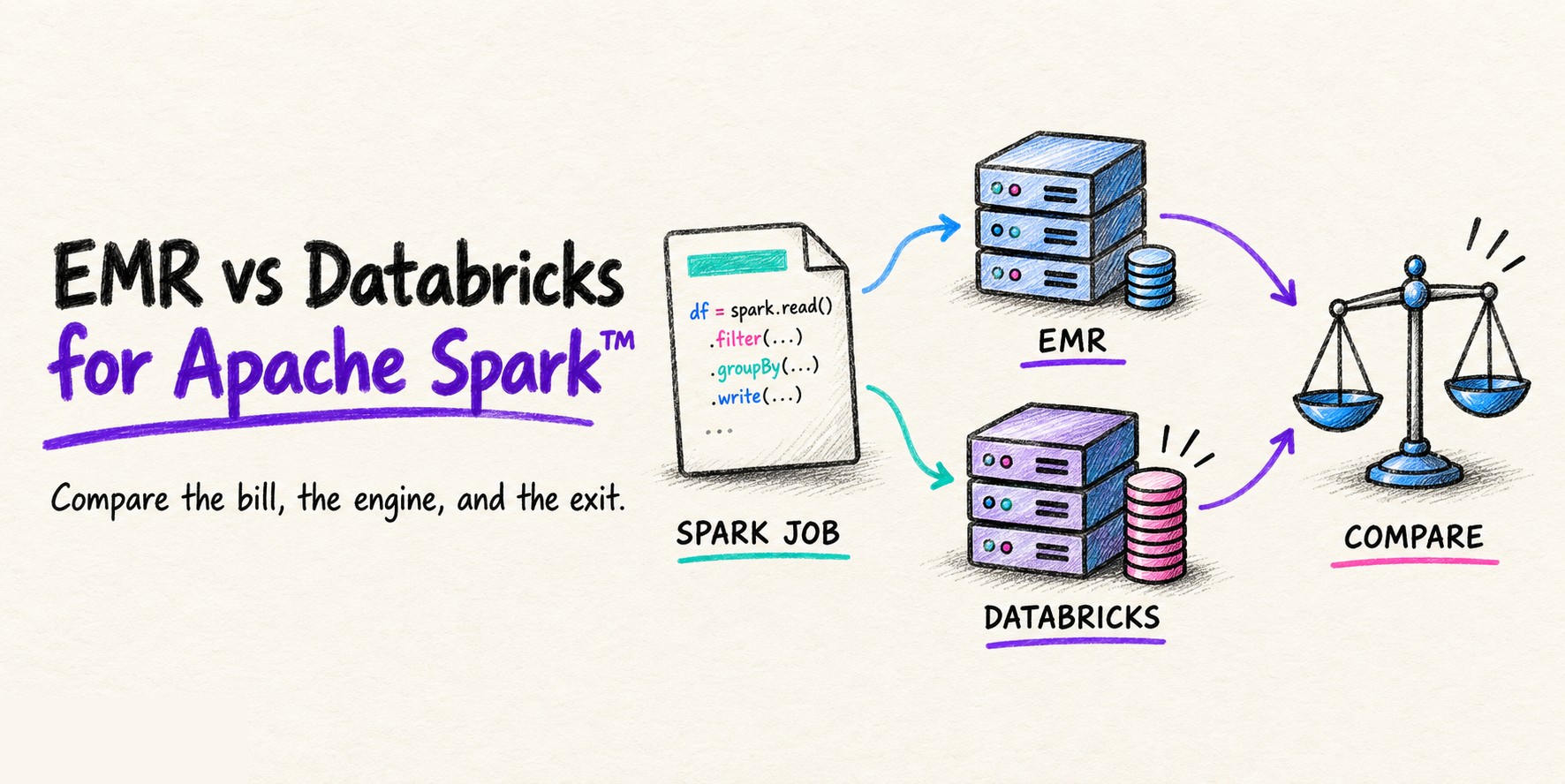
EMR fits AWS-only teams that can operate Spark and want EC2 instance-hour billing with their own discounts, while Databricks fits teams that want a managed, multi-cloud platform and accept a DBU charge on top of compute. At list prices on the same m5.xlarge node, Databricks Jobs Classic with Photon costs about twice as much per hour as EMR on EC2. Quanton, a Spark engine from Onehouse, keeps EMR or Kubernetes in place and replaces only the execution engine.
Choose Amazon EMR if your Apache Spark™ workloads live on AWS, your team can operate Spark clusters, and you want to pay EC2 instance-hours plus a small EMR fee with your own Spot and Reserved discounts. Choose Databricks if you want a managed platform across AWS, Azure, and Google Cloud, with notebooks, Unity Catalog, and the Photon engine, and you accept a per-DBU charge on top of compute.
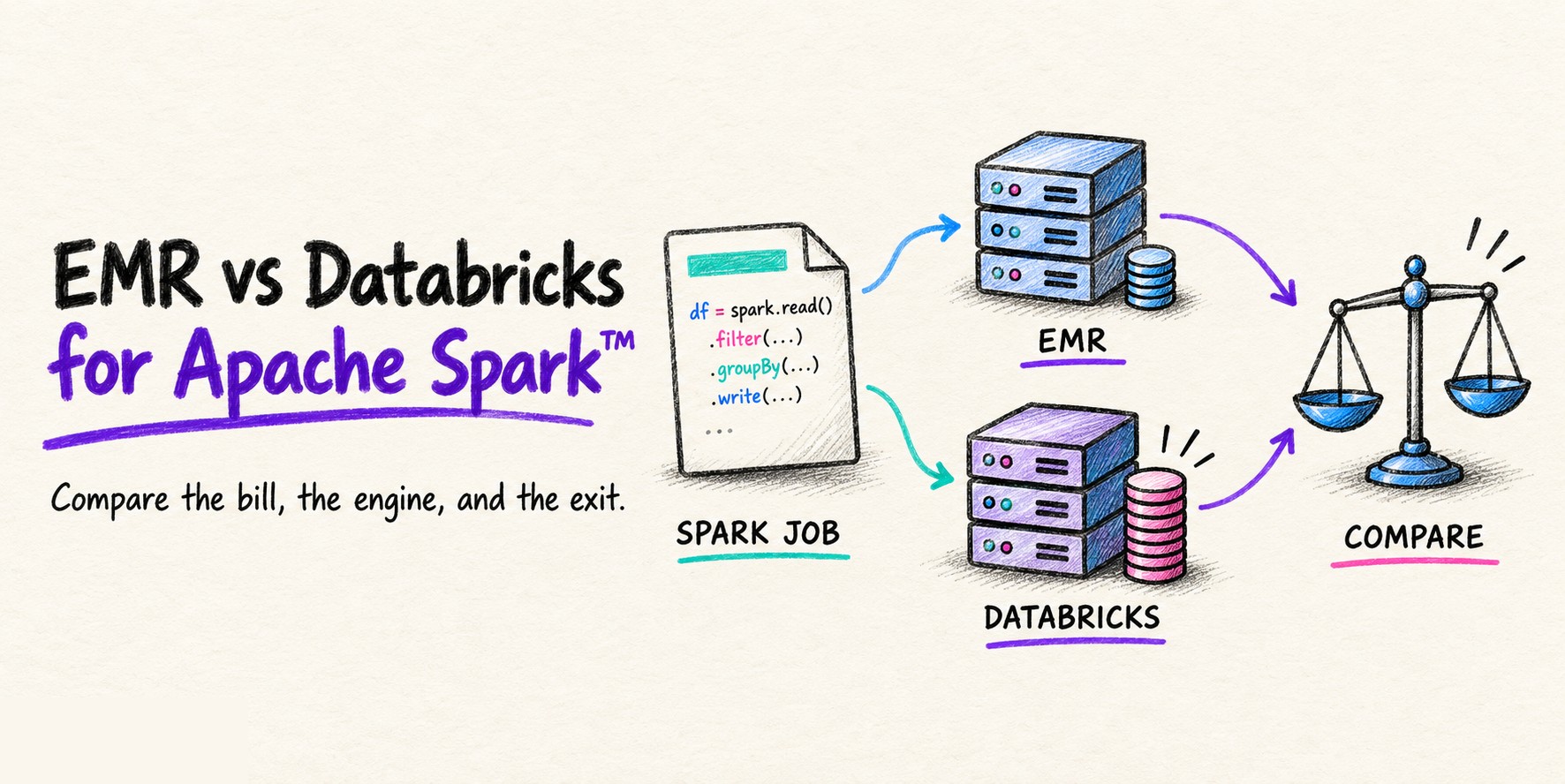
Both platforms run the same Spark APIs, so most of the decision comes down to the platform around the engine and the way each one bills. This comparison covers billing with a per-hour worked example, engine performance, deployment and governance, and the cost of switching later.
A third option is to keep the platform and replace only the Spark execution engine, for teams whose platform fits and whose engine costs too much. Onehouse builds one such engine, Quanton, covered in its own section below with its trade-offs.
Spark vs Databricks vs EMR: The engine and the platforms around it
Apache Spark is the open-source distributed engine, licensed under Apache 2.0. Databricks and EMR are both platforms that run Spark for you. Databricks was founded in 2013 by the original creators of Spark, and later created Delta Lake and MLflow. The names Spark and Databricks are sometimes used interchangeably.
The Databricks Runtime is Databricks’ own distribution of Spark. It adds proprietary components, the largest being Photon, a native vectorized engine that runs only on Databricks. The Amazon EMR runtime for Apache Spark is AWS’s performance-optimized build of Spark, which AWS describes as fully API compatible with open-source Spark.
Code written against the Spark DataFrame, SQL, and PySpark APIs runs on either platform with configuration changes. The platform layer stays behind: Photon, Databricks notebooks and workflows, Unity Catalog features, and EMR’s integration with the rest of AWS.
EMR vs Databricks at a glance
The differences that decide most evaluations are where each platform runs, how it bills Spark compute, and what happens to the cloud discounts you already have.
| Amazon EMR | Databricks | |
|---|---|---|
| Clouds | AWS only (EC2, EKS, Serverless, Outposts) | AWS, Azure, and Google Cloud |
| How Spark compute is billed | EC2 instance-hours plus a per-instance EMR fee, or a bundled rate on EMR Serverless | DBUs per hour plus cloud VMs on classic compute, or DBUs with compute bundled on serverless |
| Spark engine | EMR runtime for Apache Spark (JVM) | Databricks Runtime, with Photon (native C++) on classic or always on serverless |
| Your EC2 discounts | Apply to the EC2 portion; the EMR fee stays at list | Apply to the VM portion on classic compute; no effect on serverless |
| Catalog and governance | AWS Glue Data Catalog and AWS Lake Formation | Unity Catalog |
Status as of October 2026, from AWS and Databricks documentation. Each platform ships changes often, so confirm details before deciding.
How EMR and Databricks bill a Spark job
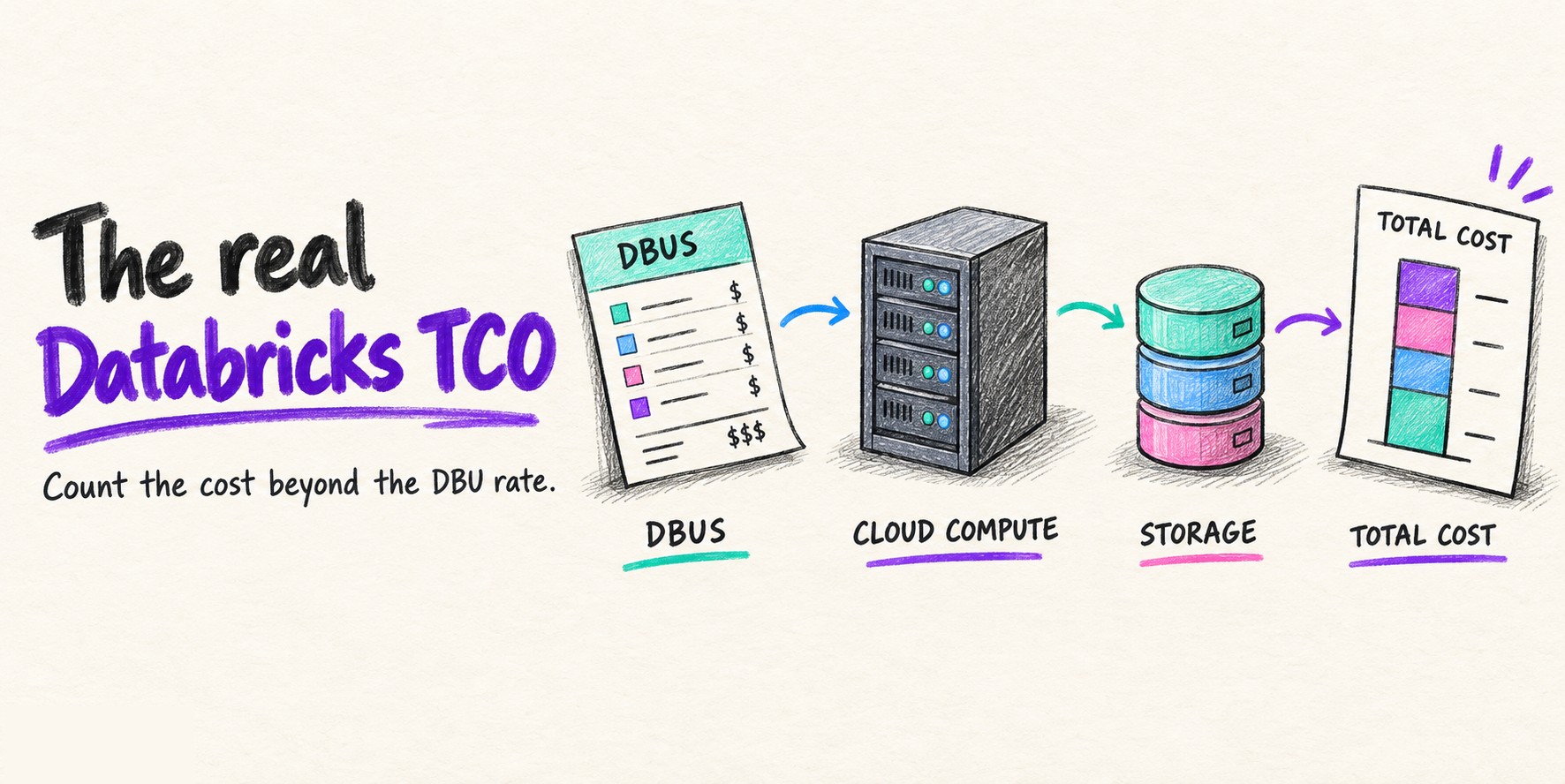
Both platforms charge per second for the compute a job uses, and both add a platform fee on top of the cloud machines. The fee is calculated differently, and that difference decides how the bill reacts to discounts and to faster engines.
EMR pricing: Instance-hours plus a per-instance EMR fee
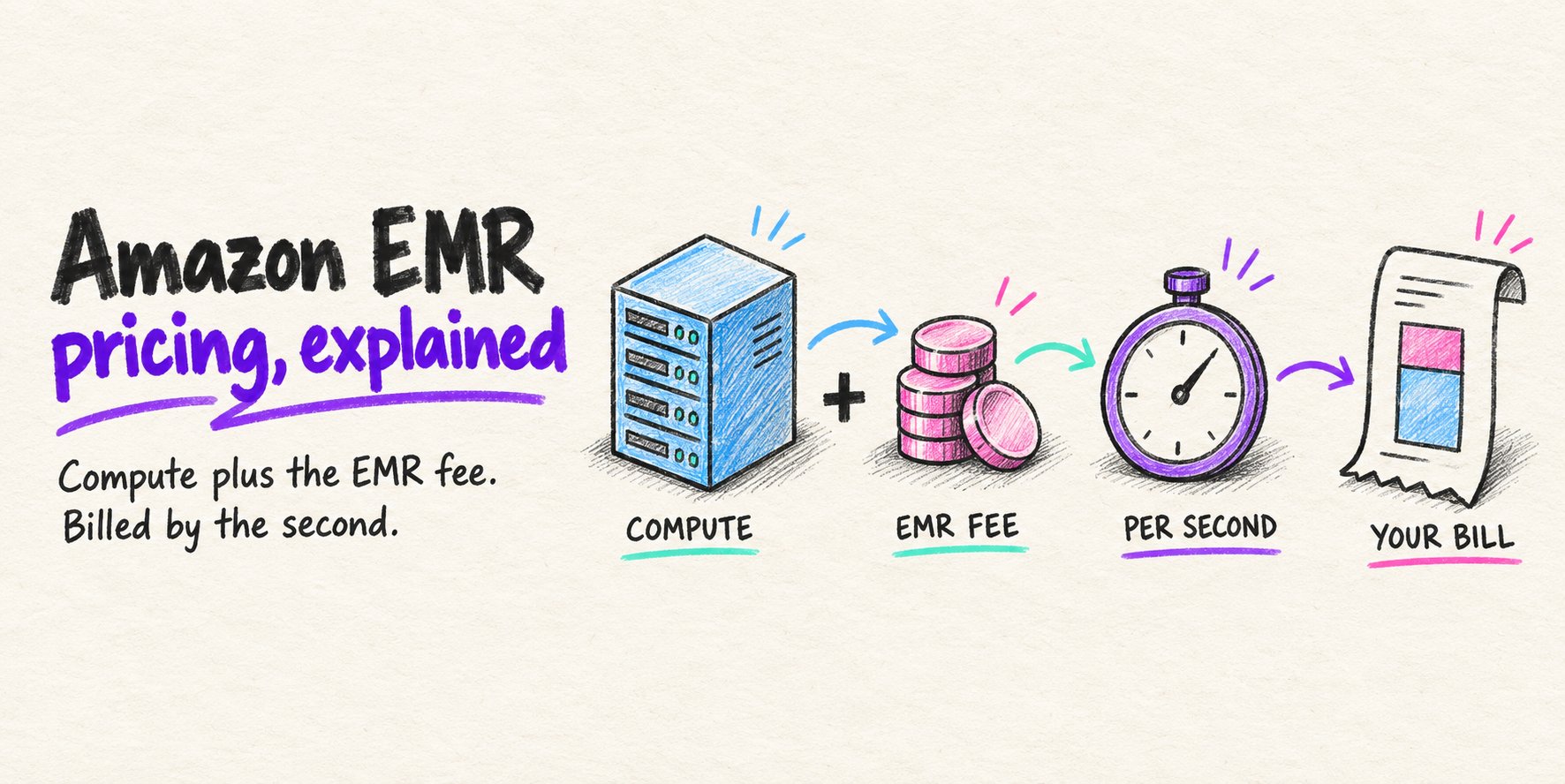
On EMR on EC2, the Amazon EMR pricing page states that the EMR price is added to the EC2 price, and both are billed per second with a one-minute minimum. AWS’s own example uses c4.2xlarge nodes in us-east-1 at $0.398 per hour for EC2 and $0.105 per hour for EMR.
EMR on EKS charges its uplift on the vCPU and memory that Spark pods request, on top of the EKS cluster and its nodes. EMR Serverless publishes one bundled rate: $0.052624 per vCPU-hour and $0.0057785 per GB-hour on x86 in us-east-1, with no separate EC2 line.
The EMR fee does not change with Spot or Reserved pricing, so the fee’s share of the bill grows as the EC2 discount grows. Our guide to EMR pricing works through each deployment model in detail.
Databricks pricing: DBUs on top of cloud VMs, or bundled in serverless
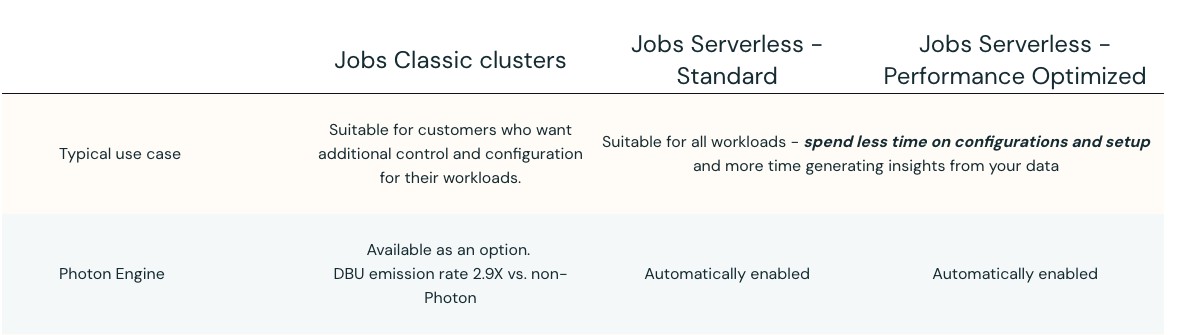
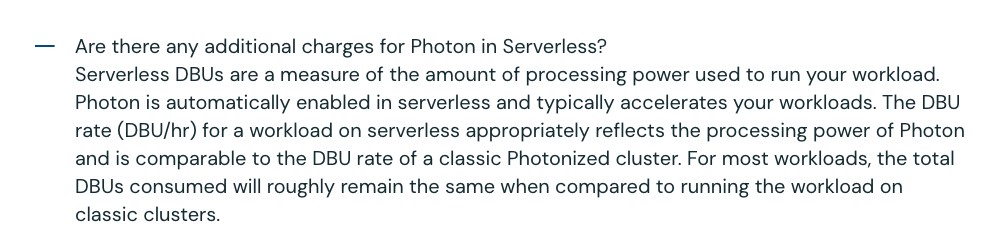
Databricks bills in Databricks Units (DBUs). On AWS at Premium-tier list prices, Jobs Classic compute costs $0.15 per DBU and Jobs Serverless costs $0.35 per DBU, according to the Lakeflow Jobs pricing page. On classic compute, AWS bills the EC2 instances separately; on serverless, the DBU rate includes them.
Each instance type carries a DBU rating. In Databricks’ instance pricing calculator, an m5.xlarge emits 0.69 DBU per hour. Photon raises that: the Lakeflow Jobs page lists Photon on Jobs Classic clusters at a 2.9× DBU emission rate against non-Photon clusters.
Databricks also sells committed-use contracts that discount DBUs in exchange for a spend commitment, listed on the Databricks pricing page. Our Databricks DBU guide covers compute types, tiers, and the full DBU formula.
Cost per node-hour: EMR vs Databricks on the same instance
List prices are easiest to compare on one instance for one hour. The table prices a single m5.xlarge (4 vCPUs, 16 GB) in us-east-1 on each option, at on-demand rates and with 70% off EC2, within the range AWS advertises for Spot Instance pricing.
| Setup (one m5.xlarge, one hour) | On-demand EC2 | 70% off EC2 |
|---|---|---|
| EMR on EC2 | $0.240 | $0.106 |
| Databricks Jobs Classic | $0.296 | $0.161 |
| Databricks Jobs Classic with Photon | $0.492 | $0.358 |
| Databricks Jobs Serverless | $0.700 | $0.700 |
| EMR Serverless (4 vCPU, 16 GB) | $0.303 | $0.303 |
List prices in us-east-1, Premium tier, October 2026. EC2 is $0.192 per hour on demand; the EMR fee is $0.048; the Databricks rating is 0.69 DBU per hour, or 2.0 with Photon. The serverless row assumes the same DBUs as Photon classic, which Databricks’ pricing FAQ describes as comparable. Estimates only; rates and contract discounts vary.
At on-demand rates, the Photon cluster costs 2.05 times as much per hour as EMR on the same instance. With 70% off EC2 the ratio rises to 3.4 times, because the discount reduces the EC2 line and leaves the DBUs and the EMR fee where they were.
For a Photon job to cost the same as the EMR job, Photon has to finish it about twice as fast at on-demand prices and about 3.4 times as fast on discounted capacity. Without Photon, Databricks Jobs Classic costs 1.23 times EMR per hour on demand. In practice, committed-use contracts lower the DBU rate, and runtime decides the total.
Spark performance: EMR runtime vs Databricks Photon
Both vendors publish large speedups over open-source Spark. Neither publishes a run against the other. The useful questions are what each engine accelerates, where it falls back, and what a head-to-head run shows.
EMR runtime: Optimized Spark on the JVM
The EMR runtime keeps Spark’s JVM execution model and adds AWS’s optimizations for metadata caching, parallel I/O, and query planning. In AWS’s own benchmark, EMR 7.12 ran TPC-DS at 3 TB 4.5 times faster than open-source Spark 3.5.6 with Apache Iceberg™ 1.10.0.
AWS reports a smaller gain on writes. On a 3 TB merge workload, AWS measured EMR 7.12 at 2.08 times the speed of open-source Spark 3.5.6 with Iceberg 1.10.0.
The EMR runtime is the same across EMR on EC2, EMR on EKS, and EMR Serverless. Because the engine stays on the JVM, UDFs and RDD code run as they do on open-source Spark, with no separate fallback path.
Databricks Photon: A native engine with documented gaps
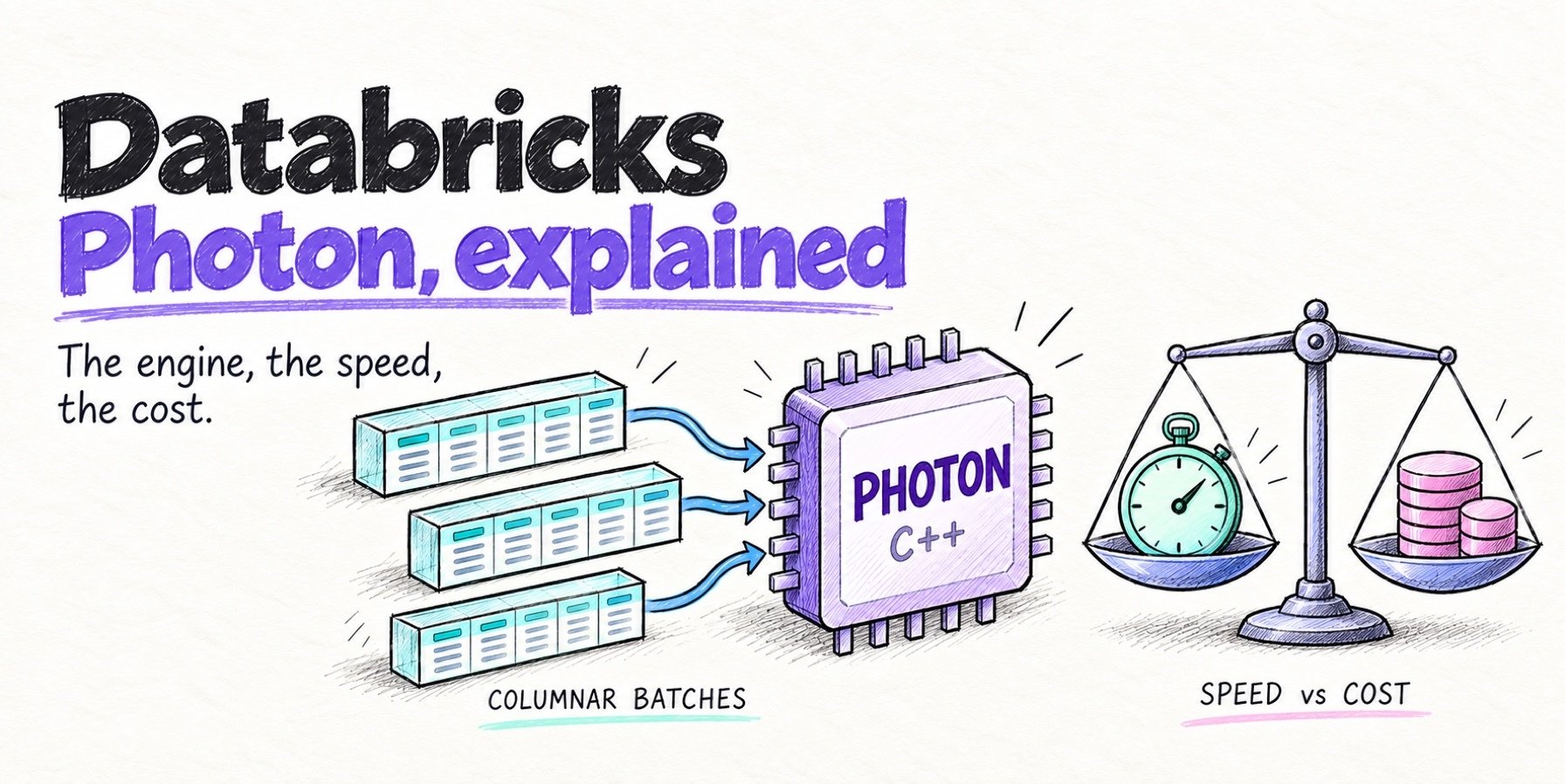
Photon is a C++ vectorized engine that takes over the operators it supports and hands the rest back to the Databricks Runtime. According to the Photon documentation, Photon is on for serverless compute and SQL warehouses and on by default for classic compute, while clusters created through the Clusters or Jobs API must set runtime_engine to PHOTON.
The same page lists the gaps. Photon does not support UDFs, RDD APIs, or Dataset APIs, and supports only stateless streaming. Photon instance types also consume DBUs at a different rate, which is where the 2.9× multiplier above comes from.
A Photon cluster therefore saves money only on jobs Photon covers well, such as large scans, joins, and aggregations in SQL and DataFrame code. Our guide to Databricks Photon works through which workloads clear the DBU bar.
Head-to-head results on current releases
Public head-to-head runs between current EMR and Databricks releases are scarce. In Onehouse’s own runs on TPC-DS 10 TB and 1 TB LakeLoader merges on Graviton instances, EMR 7.12 improved 32% over earlier EMR versions, which Onehouse found brought EMR’s price/performance within range of Photon on those workloads.
That result covers price/performance on two workloads, not speed on every job. A UDF-heavy PySpark pipeline that Photon cannot accelerate pays the Photon rate for JVM execution, while a SQL-heavy pipeline may finish fast enough on Photon to cover the multiplier. Running two or three representative jobs on both platforms settles the question for your own workloads.
Deployment, governance, and the rest of the platform
EMR offers four deployment models: EMR on EKS for teams that already run Kubernetes, EMR on EC2, EMR Serverless, and EMR on Outposts. All of them run inside AWS. Teams on Azure or Google Cloud need a different service there.
Databricks runs on all three major clouds. In its platform architecture, the control plane runs in Databricks’ account; classic compute runs in your AWS account, and serverless compute runs in Databricks’ account in the same region. That split decides whether your VPC controls and EC2 discounts apply.
Governance follows the platform. EMR uses the AWS Glue Data Catalog and can enforce fine-grained permissions through EMR’s Lake Formation integration. Databricks centers governance on Unity Catalog, and Databricks adds notebooks, workflows, SQL warehouses, and machine learning tooling in the same workspace.
Lock-in and the cost of switching later
Spark code is portable between EMR and Databricks; the platform features around it are not. A job that uses only Spark SQL and DataFrames moves with configuration changes, while a job built on Databricks notebooks, Lakeflow pipelines, or Delta-specific features carries rework with it.
Photon adds a second dependency. A pipeline tuned to Photon’s speed has no Photon to run on outside Databricks, so moving it means accepting a different runtime profile or replacing the engine elsewhere. On EMR, the lock-in is to AWS itself: EMR does not run on other clouds.
Open table formats lower both kinds of switching cost. Data stored as Apache Hudi™, Iceberg, or Delta Lake tables in your own object storage stays readable by other engines, which makes it possible to test a second platform or engine on the same data before committing.
Quanton: Keep the platform, swap the Spark engine
When the platform fits and the engine bill is the problem, a different engine changes the cost without a migration. Quanton replaces Spark’s execution engine and leaves the platform, the data, and the jobs where they are.
A drop-in Spark engine for EMR and Kubernetes
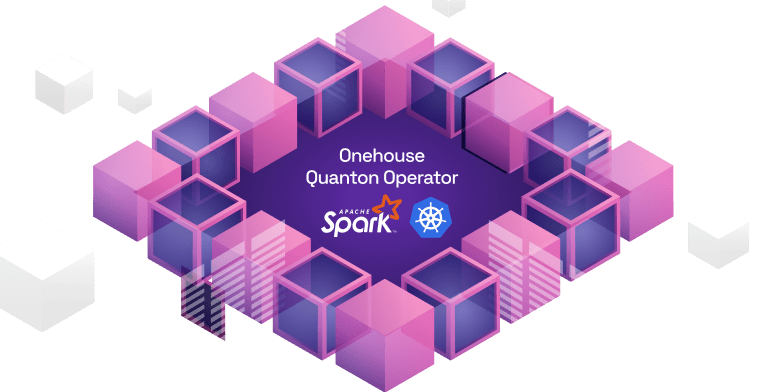
Quanton is the Spark engine from Onehouse, available on its own at quanton.dev, and it runs without the Onehouse platform. The Quanton engine is built on Velox with optimized and reimplemented operators, and existing Spark jobs run with no code changes.
The engine is storage-aware and end-to-end: storage-aware planning reads Iceberg and Hudi table metadata and reshapes the query plan around it, and Quanton optimizes the read, the compute, and the write.
Quanton runs on any Kubernetes cluster, on-prem or in the cloud, on VMs, and inside existing Spark platforms. On EMR, that means EMR on EKS, with Quanton packaged as a custom image following the AWS EMR on EKS custom image docs. On AWS, the EKS setup guide covers a standard install. Quanton has an open core, a free tier for the first 100 GiB processed each month, and reverts to open-source Spark with one config line.
Quanton bills per GiB of data processed instead of per instance-hour or per DBU, starting at $0.0009 per GiB read after the free tier on the Quanton pricing page. The instances run in your own account, so Spot and Reserved discounts apply to all of the compute, and a faster job cuts instance hours without changing the Quanton fee.
Benchmark: Quanton vs EMR and Photon
Onehouse benchmarked Quanton against EMR 7.12 on TPC-DS 10 TB and 1 TB LakeLoader merges, using current general-purpose Graviton instances. On those workloads, Quanton delivered 2.5 times better price/performance than EMR 7.12 in Onehouse’s EMR benchmark.
Against Photon the gap is smaller. On TPC-DS 10 TB (all 99 queries) on 11 m8gd.4xlarge instances, Quanton finished in 2,034 seconds, Databricks Photon on DBR 18.2 in 2,550 seconds, and open-source Spark in 12,200 seconds. These results are derived from TPC-DS, and the full setup is on the Quanton benchmarks page.
With performance that close on TPC-DS-style workloads, the difference from Photon comes from the billing model: there is no DBU charge, and EC2 discounts apply to all of the compute. In production, a large US airline that moved from EMR to Quanton on EKS cut Spark costs 60%, according to Onehouse’s EMR results.
Trade-offs to weigh
The benchmarks above are Onehouse’s own runs, and no independent party has reproduced them yet. Onehouse is also a younger vendor than AWS or Databricks.
Quanton is open core, so parts of the engine are under a commercial license. Billing tracks the volume of data processed, so scan-heavy jobs with light compute see less benefit from a faster run. Quanton replaces only the execution layer, so notebooks, catalogs, and orchestration stay on the platform you run today.
Should you choose EMR or Databricks?
Choose EMR if your data and teams are on AWS, your engineers can size and operate Spark clusters, and your workloads include UDF-heavy or RDD code that Photon would not accelerate. EMR’s billing keeps the platform fee below a DBU charge on the same instance and lets EC2 discounts cut most of the bill.
Choose Databricks if you need one platform across clouds, your teams work in notebooks and SQL warehouses, and governance through Unity Catalog matters more than the per-hour rate. Measure your main jobs with and without Photon before committing, because Photon has to cut runtime substantially to pay for its DBUs.
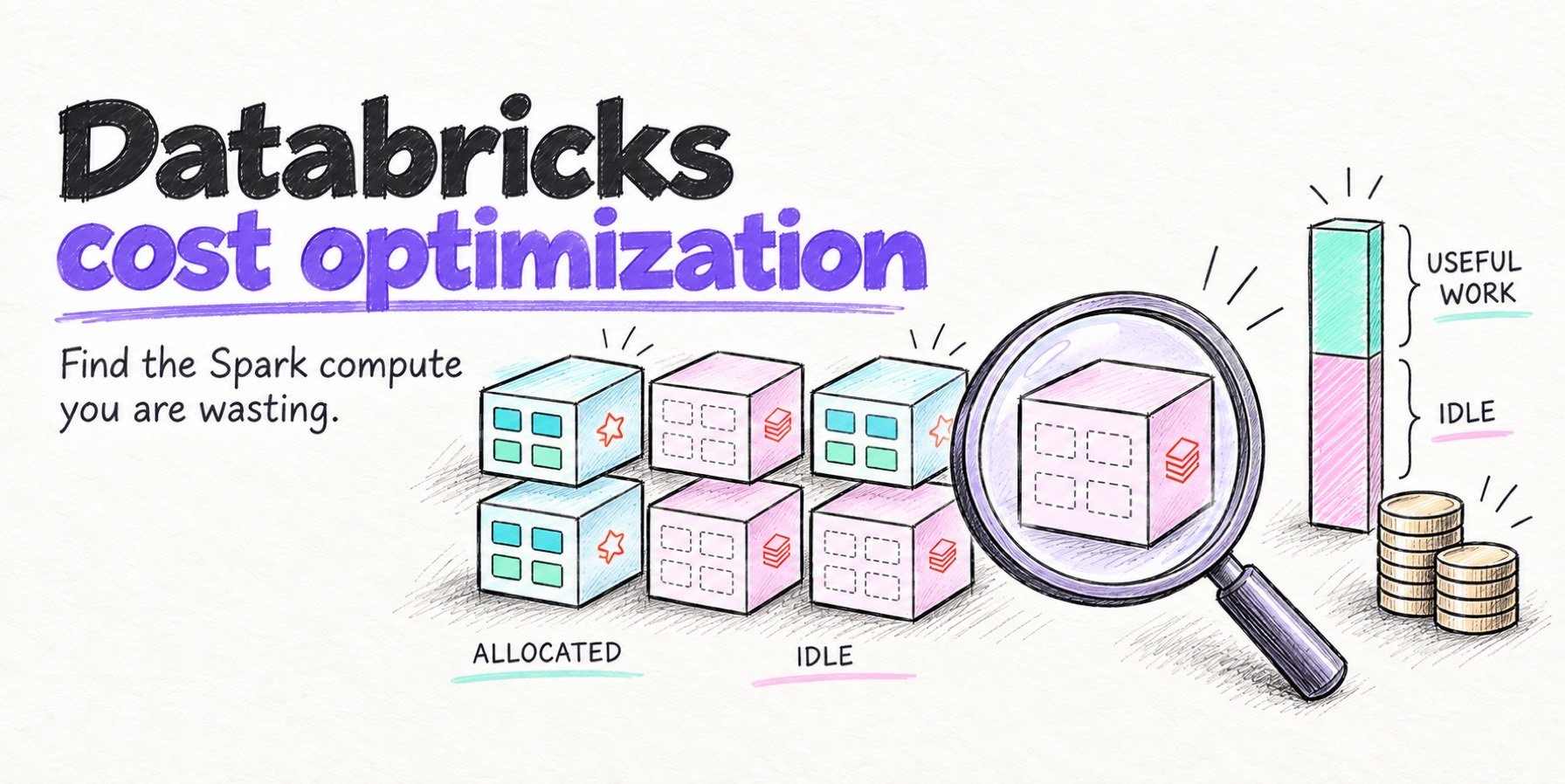
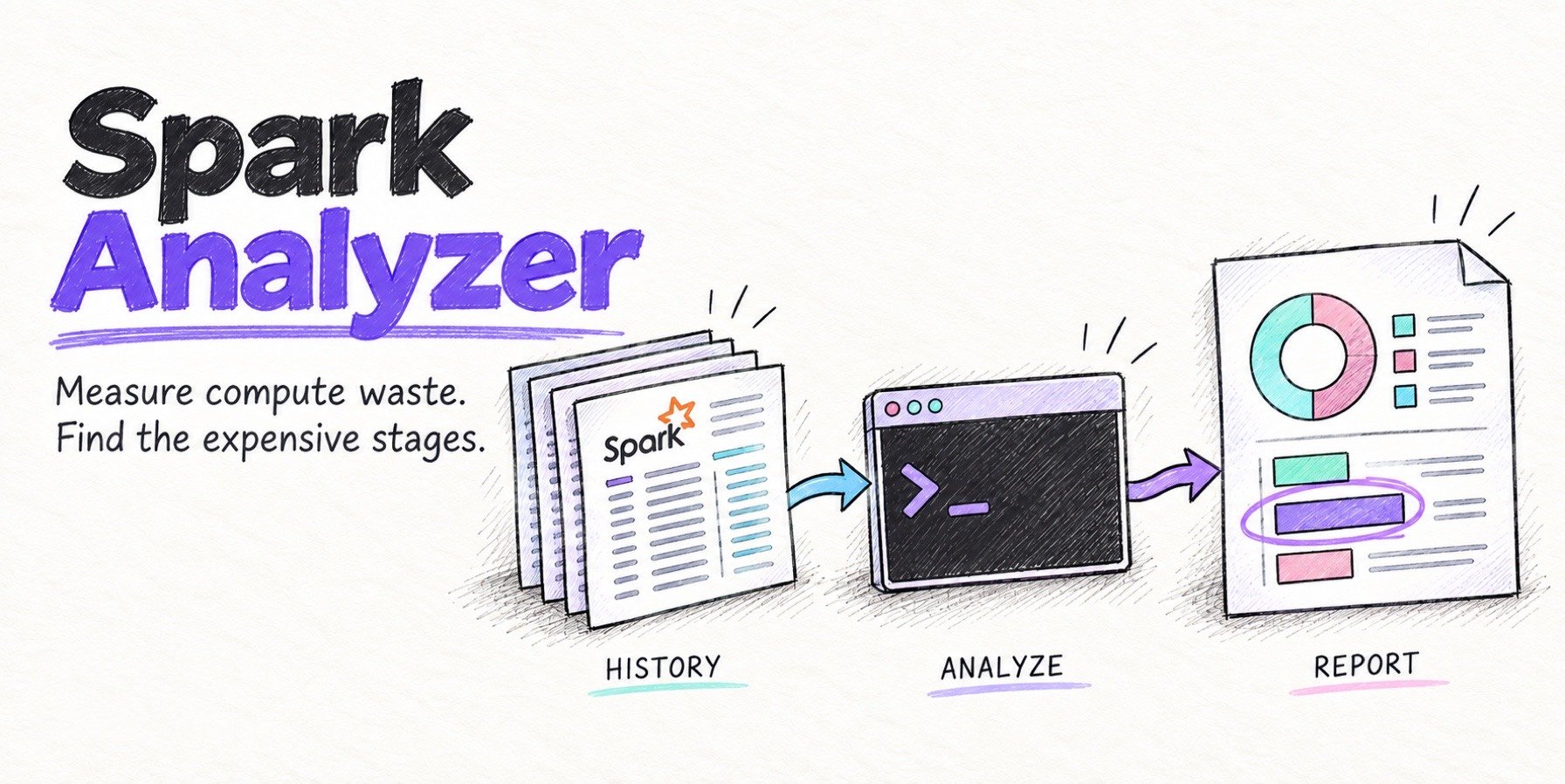
If the platform fits but the Spark bill is the problem, measure the waste first with the free Spark cost analyzer, then test an engine swap. Quanton runs without the Onehouse platform, so the comparison needs no platform change: create an account and run one EMR or Kubernetes job side by side in your own VPC.
Frequently asked questions
Is Databricks more expensive than EMR?
Per node-hour at list prices, yes: in the worked example above, Databricks Jobs Classic costs more per hour than EMR on EC2 on the same instance, and Photon widens the gap. Total job cost depends on runtime and on any committed-use discount, so a job that runs much faster on Databricks can cost less there.
Can EMR read Databricks Unity Catalog tables?
Yes. AWS has documented how EMR reads and writes Databricks Unity Catalog tables through Unity Catalog’s Open REST APIs. AWS’s walkthrough uses EMR Serverless, with release 7.8.0 or higher for Iceberg tables.
That lets one team run Spark on EMR against tables another team manages in Databricks, so the choice does not have to be all one platform.
Does EMR use Kubernetes?
One deployment model does. EMR on EKS runs Spark jobs as pods on an Amazon EKS cluster you operate, while EMR on EC2 runs on clusters of EC2 instances and EMR Serverless manages capacity for you, so neither of those requires Kubernetes.
Is Quanton open source?
Quanton has an open core; the docs and GitHub describe what is open and what is under a commercial license. The free tier needs no credit card, and past its monthly allowance jobs fall back to open-source Spark with Apache DataFusion™ Comet and Apache Gluten™ pre-installed. The Quanton FAQ covers licensing and deployment.
Author
Bhavani Sudha Saktheeswaran
Head of Open Source
Sudha is the Head of Open Source at Onehouse and a PMC member of the Apache Hudi project. She comes with vast experience in real-time and distributed data systems through her work at Moverworks, Uber and Linkedin’s data infra teams. She is a key contributor to the early Presto integrations of Hudi. She is passionate about engaging with and driving the Hudi community.