Talk with our engineers by joining the new Onehouse community Slack!
TL;DR
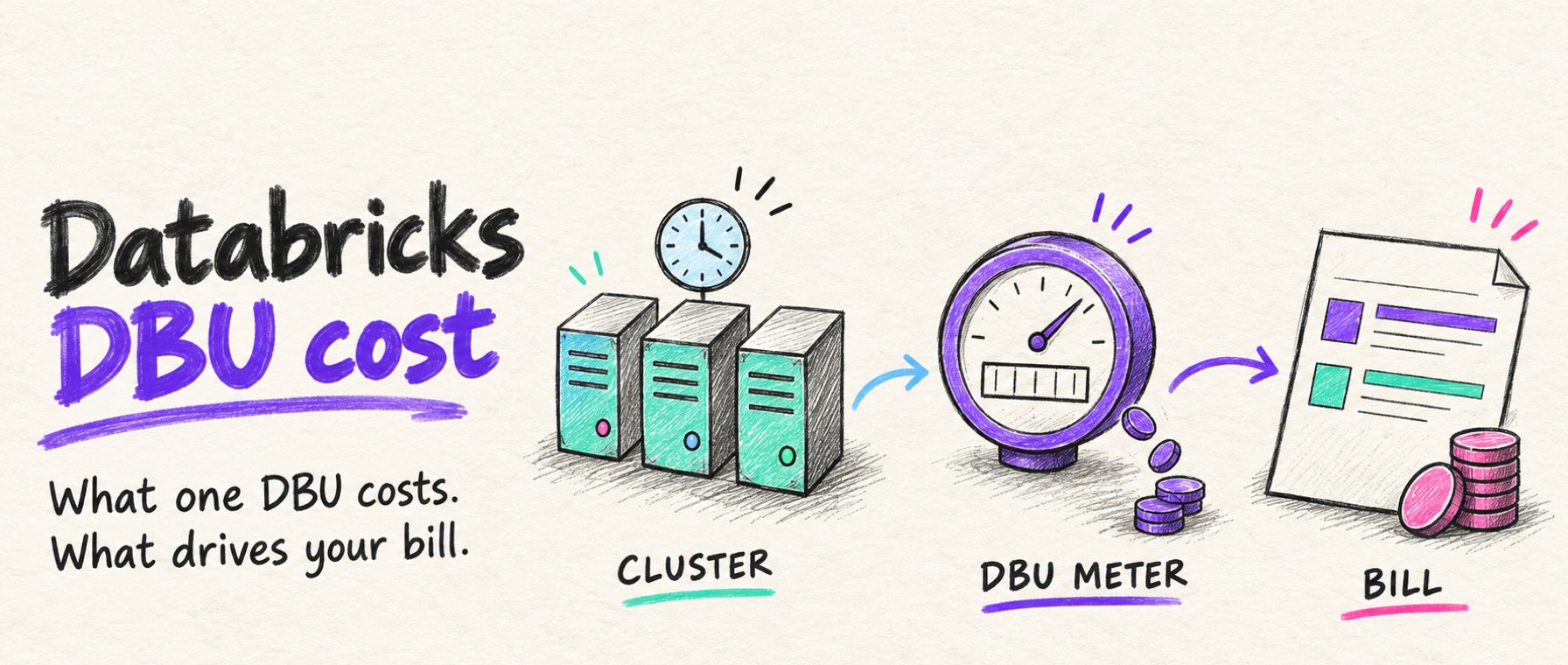
A Databricks bill is DBUs consumed times the price per DBU, plus the cloud VMs on classic compute. Compute type and tier set the rate, from $0.15 on Jobs Classic to $0.75 on serverless all-purpose at Premium list prices, while cluster size, runtime, Photon's 2.9x multiplier and idle time set how many DBUs you burn, and serverless bundles in VMs your EC2 discounts can't reach. Quanton runs Spark in your own cloud account with no DBU on the bill, billing per GiB processed, so your EC2 discounts cover all the compute and a daily 1 TB ETL job is estimated at 2.7x less than Databricks Classic with Photon.
A Databricks Unit (DBU) is the unit Databricks uses to bill compute. At Premium-tier list prices on AWS, one DBU costs $0.15 on a classic jobs cluster and $0.75 on serverless all-purpose compute. Enterprise-tier rates are higher.
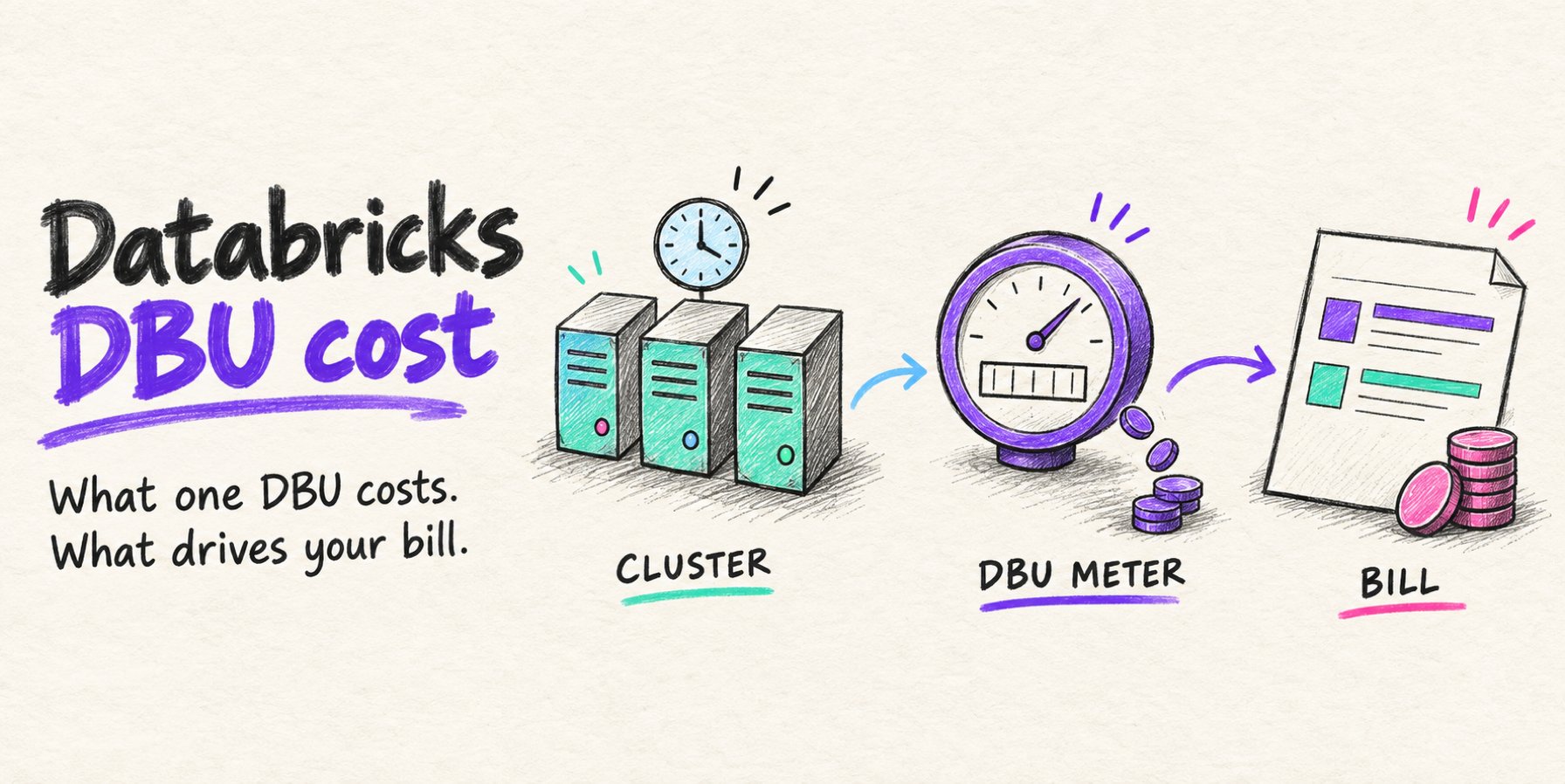
The rate is only one input. The bill is DBUs consumed multiplied by the rate, and on classic compute your cloud provider bills the virtual machines separately.
The compute type and tier set the price per DBU. Cluster size, Photon, and runtime set how many DBUs a job consumes, so two teams running the same Apache Spark™ job can pay very different amounts.
What is a Databricks DBU?
Databricks defines a DBU as a normalized unit of processing power used for measurement and pricing. The Databricks pricing overview adds that the number of DBUs a workload consumes is driven by processing metrics, which may include the compute resources used and the amount of data processed. Usage is billed per second.
On classic compute, each instance type carries a DBU rating: the DBUs it emits per hour while it runs. In Databricks’ instance pricing calculator, an m5.xlarge (4 vCPUs, 16 GB) is rated at 0.69 DBU per hour.
A cluster emits the sum of its nodes’ ratings, driver included, for every second the cluster is up. The meter runs whether the executors are running tasks or sitting idle, so idle time costs the same as busy time.
Databricks DBU cost by compute type and tier
The price of one DBU depends on what the workload is: a scheduled job, an interactive notebook, or a SQL warehouse. The pricing tier and the cloud then move the rate again.
List prices for jobs, all-purpose, and SQL compute
Jobs compute runs scheduled, automated workloads and has the lowest rate on the Lakeflow Jobs pricing page. All-purpose compute serves interactive notebooks and costs several times more per DBU on the same hardware. SQL warehouses have their own SKUs on the SQL warehouse pricing page.
| Compute type | Price per DBU | Cloud VMs |
|---|---|---|
| Jobs Classic | $0.15 | Billed separately by your cloud provider |
| Jobs Serverless | $0.35 | Included in the DBU rate |
| All-Purpose Classic | $0.55 | Billed separately by your cloud provider |
| All-Purpose Serverless | $0.75 | Included in the DBU rate |
| SQL Classic / SQL Pro | $0.22 / $0.55 | Billed separately by your cloud provider |
| SQL Serverless | $0.70 | Included in the DBU rate |
Premium-tier list prices on AWS, US East (N. Virginia), from Databricks’ pricing pages in October 2026. Rates vary by region and change over time, so confirm them before modeling.
Serverless rates are higher because they include the virtual machines, so a serverless rate and a classic rate are not directly comparable. Jobs against all-purpose is a direct comparison: on the same classic hardware, $0.55 is 3.7 times $0.15.
Premium, Enterprise, and the end of the Standard tier
Enterprise on AWS adds security and compliance features at higher rates. With the Enterprise plan selected, Databricks lists Jobs Classic at $0.20 per DBU, Jobs Serverless at $0.45, All-Purpose Classic at $0.65, and All-Purpose Serverless at $0.95.
The Standard tier no longer sets the floor. Databricks announced its end of life, and Standard workspaces were upgraded to Premium on October 1, 2025 on AWS and Google Cloud and on October 1, 2026 on Azure, according to Databricks’ Compute for Data Science pricing page. The Lakeflow Jobs pricing FAQ lists Standard-tier Jobs Compute at $0.10 per DBU on AWS, so a jobs workload that moved to Premium now pays 50% more per DBU.
List prices are a ceiling. Databricks offers committed-use contracts that discount DBUs in exchange for a usage commitment. On Azure, Microsoft advertises up to 37% off pay-as-you-go DBU prices for a one- or three-year pre-purchase of Databricks Commit Units on the Azure Databricks pricing page.
How to calculate your Databricks DBU cost
On classic compute, the math is the same for every SKU. Work out the DBUs a run consumes, multiply by the rate, then add what your cloud provider charges for the machines.
The formula: DBU rating, nodes, hours, and rate
DBU cost per run equals the DBU rating per node, times the number of nodes, times the hours the cluster runs, times the price per DBU. Photon on a classic cluster multiplies the DBU rating by its emission factor.
The DBU line is not the whole bill. On classic compute, AWS, Azure, or Google Cloud bills the virtual machines, attached disks, object storage, and network egress separately. Lakemine’s DBU guide notes that on AWS and Google Cloud classic compute, the infrastructure charge commonly equals or exceeds the DBU charge.
Azure Databricks is the exception in billing terms: Microsoft puts both charges on one Azure invoice.
A worked example on a 10-node jobs cluster
Take a 10-node m5.xlarge jobs cluster on Premium in us-east-1 that runs for two hours a day. At 0.69 DBU per node-hour, one run consumes 13.8 DBUs, which costs $2.07 at $0.15 per DBU. The instances cost $0.192 per hour each at AWS on-demand rates, adding $3.84.
One run costs $5.91, or about $177 a month at 30 runs. The DBU charge is 35% of that total, and the EC2 charge is the other 65%. On Enterprise, the same run’s DBU charge rises to $2.76.
The compute type moves the total more than the tier does. If the same job runs on an all-purpose cluster, its 13.8 DBUs cost $7.59 at $0.55 per DBU, and the run costs $11.43, nearly double the jobs-cluster price.
Checking real DBU spend in system tables
An estimate is a starting point. The actual figures live in Databricks’ billing system tables: system.billing.usage records DBUs by SKU, cluster, job, and tag, and system.billing.list_prices holds the list price of each SKU over time.
Joining the two tables gives list-price dollars per job, workspace, or tag, and the Databricks system tables docs include sample queries for it. The join returns list prices, so apply your contract’s discount to the DBU totals.
Cloud VM costs do not appear in these tables. They come from your cloud provider’s bill, matched by cluster tags.
What drives your Databricks DBU bill up
Three choices push DBU spend up: running scheduled jobs on the wrong compute type, enabling Photon where the speedup does not cover its multiplier, and paying for capacity that sits idle. Each one changes a different term in the formula.
All-purpose clusters running scheduled jobs
A scheduled job attached to an all-purpose cluster bills at the all-purpose rate instead of the jobs rate, on identical hardware. This happens when a notebook developed on a shared cluster is scheduled without moving to a job cluster.
The billing system tables show which jobs do this. Filter system.billing.usage for all-purpose SKUs on usage records that carry a job ID.
Photon’s DBU multiplier on classic clusters
On classic compute, Photon is a toggle that raises the DBU emission rate. In its pricing comparison table, Databricks lists Photon on Jobs Classic clusters at a 2.9× DBU emission rate against non-Photon clusters, and the all-purpose compute pricing lists 2× for All-Purpose Classic. Photon usage appears on the bill as “Jobs Compute (Photon)” or “All Purpose Compute (Photon).”
Apply that to the worked example. With Photon on, the 10-node run consumes 40.02 DBUs instead of 13.8, so the DBU charge rises from $2.07 to $6.00. If runtime stays the same, the run costs $9.84 instead of $5.91, about two-thirds more.
Photon lowers the bill only when it shortens the job enough to cover the multiplier. On this cluster at on-demand EC2 rates, the job has to run about 1.7 times faster, cutting runtime by roughly 40%, to break even. Our guide to Databricks Photon covers which workloads clear that bar, which see little gain, and where unsupported operations fall back to standard Spark while the cluster still bills at the Photon rate.
Idle executors, oversized clusters, and long timeouts
Clusters sized for the widest stage of a job bill for that width through every narrow stage. All-purpose clusters with generous auto-termination windows bill through the idle time after the last command, and a minimum-workers floor raised during an incident and never lowered keeps nodes billing between jobs.
Runtime waste adds DBU-hours the same way. Spill, garbage collection, stragglers from skewed join keys, speculative duplicates, and task retries all stretch a job without producing output. Each has a Spark UI signature, and the Databricks cost optimization guide shows how to confirm and fix each one.
Measuring comes first. The free Spark Analyzer CLI (pip install spark-analyzer) reads your Spark History Server, accepts Databricks as a platform setting, and reports allocated compute against useful work for each application. Onehouse’s Spark Analyzer walkthrough reports that, across the organizations Onehouse has analyzed, 30 to 70% of Spark compute is typically wasted.
Serverless DBUs and the EC2 discounts you give up
Serverless DBU rates include the cloud infrastructure, so there is no separate EC2 line, and Photon is enabled automatically. Databricks’ Lakeflow Pipelines pricing FAQ states that the serverless DBU rate is comparable to that of a classic Photon cluster. The same FAQ says total DBUs stay roughly the same as on classic clusters for most workloads.
Using that guidance on the worked example: if the serverless run consumes the same 40.02 DBUs as the Photon classic run, it costs $14.01 at the Jobs Serverless rate, compute included. The Photon classic run costs $9.84 at on-demand EC2 rates, and $7.92 if Spot or Reserved capacity takes 50% off the EC2 portion. Serverless jobs also offer a standard performance mode that bills the same SKU but consumes fewer DBUs, which Databricks says is up to 70% cheaper for some workloads, in exchange for a 4 to 6 minute startup.
That gap is the discount question. On classic compute the VMs run in your account, so Spot, Reserved Instances, Savings Plans, and any negotiated EC2 rate reduce the infrastructure portion of the bill. On serverless, the VMs run in Databricks’ account, and those discounts have nothing to apply to.
Serverless still has real advantages. According to the Lakeflow Jobs pricing FAQ, Databricks does not bill VM startup time, applies a one-minute minimum, and winds down idle resources, which favors short or bursty workloads. Serverless DBUs are also harder to forecast: there is no per-instance rating, and Databricks recommends running representative workloads and measuring the DBUs they consume.
How to lower your Databricks DBU cost
Two kinds of change lower DBU spend: consuming fewer DBUs, and paying less per DBU. Consuming fewer is usually the larger lever, because fewer DBU-hours on classic compute also means fewer VM-hours.
Fewer DBUs: Compute type, cluster size, and waste
Move scheduled work from all-purpose to job clusters and enforce the change with cluster policies. On the all-purpose clusters that remain, set short auto-termination windows.
Size clusters to the job’s sustained parallelism rather than its peak, and let autoscaling cover the peaks. The Spark waste-hunting guide measures a job’s real utilization as total task time divided by total executor uptime, and anything below 100% is billed idle time.
Autoscaling only scales down when executors are free to go. The dynamic allocation deep dive covers the cached-data and shuffle settings that keep executors pinned.
Spot instances cut the VM portion of a classic bill and leave DBUs unchanged. Databricks’ own cost optimization best practices cover instance family selection, autoscaling, and Spot for fault-tolerant batch work.
Lower rates: Commitments and the per-hour ceiling
Committed-use contracts lower the price per DBU in exchange for a spend commitment. They pay off when usage is predictable, and they lock that spend to the platform for the term.
Every lever above still bills compute-hours at a platform rate. A faster engine on Databricks shortens those hours, but Photon charges more DBUs per hour to deliver the speedup, so the savings depend on the job.
Quanton: A Spark engine with no DBU on the bill
Quanton, the Spark engine from Onehouse, is available on its own at quanton.dev and runs without the Onehouse platform. Quanton is a drop-in replacement for the Apache Spark execution engine, built on Velox, the open-source C++ engine that originated at Meta, with reimplemented operators. The engine has an open core, includes a free tier for the first 100 GiB processed each month, and reverts to open-source Spark with one config line.
Per-GiB billing in your own cloud account
Quanton runs as a Kubernetes operator on EKS, GKE, or AKS, directly on VMs, or inside an existing Spark platform such as Amazon EMR, in your own cloud account or on-prem. Jobs written against standard Spark APIs run without code changes.
According to the Quanton release notes, Quanton supports vended credentials for Apache Iceberg™ tables through any Iceberg REST catalog, including Databricks Unity Catalog. That lets a Quanton job read the same Iceberg tables a Databricks job reads.
Quanton’s charge is based on data processed: GiB read and written, times a volume-tiered rate that starts at $0.0009 per GiB read after the free tier, according to the Quanton FAQ. There is no per-DBU or per-cluster charge. Because the fee tracks data volume, a faster job cuts instance hours without raising the Quanton fee.
The machines run in your account, so Spot, Reserved, and Savings Plans discounts apply to all of the compute. Quanton replaces the execution engine only. Notebooks, Databricks SQL warehouses, Lakeflow pipelines, and jobs that depend on Databricks-only runtime features stay on Databricks.
The engine feature comparison lists what Quanton and Databricks each cover. Scheduled Spark jobs on jobs compute are the natural first candidates for a side-by-side run.
Benchmark and cost estimate: Quanton vs Databricks
Performance between Quanton and Photon is close. On TPC-DS 10 TB (all 99 queries) on the same 11-node m8gd.4xlarge cluster, Quanton finished in 2,034 seconds and Databricks Photon on DBR 18.2 in 2,550 seconds, making Quanton 25% faster.
Open-source Spark took 12,200 seconds on the same cluster, about 6× Quanton’s runtime. These are engineering comparisons using TPC-DS, not audited TPC results, and the full runs are on the Quanton benchmarks page.
With performance this close, the difference on a DBU bill comes from cost structure. Quanton’s TCO calculator includes a daily 1 TB ETL preset, and it conservatively gives Quanton and Photon equal runtime on identical hardware, with the same EC2 discount on Quanton and Databricks Classic.
| Setup (daily 1 TB ETL, 30 runs a month) | Estimated monthly cost | vs Quanton |
|---|---|---|
| Quanton (BYOC) | ~$44 | baseline |
| Databricks Classic + Photon | ~$116 | 2.7× |
| Databricks Serverless | ~$230 | 5.3× |
| Open-source Spark | ~$107 | 2.5× |
Quanton TCO calculator, daily 1 TB ETL preset, pulled October 2026: 1,000 GiB read and 200 GiB written per run, 11 nodes at about $0.72 per node-hour on demand with a 50% EC2 discount, 0.15-hour runtime for Quanton and Photon, 6× that runtime for open-source Spark, and DBU rates of $0.15 (Classic) and $0.35 (Serverless) on Premium, US-East-1. Estimates only; rates move.
For simplicity, the EC2 cost is identical on the Quanton and Databricks Classic rows, $0.59 per run, so the difference is the platform fee: $0.86 per run for Quanton against $3.28 in Photon DBUs. Databricks Serverless costs the most because the 50% EC2 discount cannot apply to bundled compute. The DBU rates here are list prices, and a committed-use contract lowers them. At 37% off, the largest pre-purchase discount Microsoft advertises for Azure Databricks, Databricks Classic + Photon comes to about $80 a month and Serverless about $145, still 1.8× and 3.3× the Quanton cost. These figures give Photon the same runtime as Quanton. At the 25% gap from the TPC-DS run, Databricks Classic + Photon comes to about $146 a month at list prices and Serverless about $288, 3.3× and 6.6× the Quanton cost.
Is your Databricks DBU cost too high?
A Databricks DBU cost comes down to DBUs consumed times the price per DBU, plus the cloud bill on classic compute. Compute type and tier set the rate. Cluster size, runtime, Photon, and idle time set how many DBUs you consume.
The first step costs nothing: query the billing system tables, move scheduled jobs off all-purpose clusters, and measure wasted compute. If the remaining spend is still large, Quanton runs in your own cloud account, keeps your EC2 discounts, and bills per GiB instead of per DBU.
Quanton runs without the Onehouse platform, so the comparison needs no platform change. To compare one Databricks job against Quanton in your own VPC, create an account and run them side by side.
Frequently asked questions
What is the cost of 1 DBU?
It depends on the compute type and tier. At Premium list prices on AWS, one DBU costs $0.15 on Jobs Classic, $0.22 to $0.70 for SQL warehouses, and up to $0.75 on serverless all-purpose compute. Enterprise rates run from $0.20 for Jobs Classic to $0.95 for serverless all-purpose compute, and Databricks’ AI products start at $0.07 per DBU on the Databricks pricing page.
How much does Databricks cost per year?
There is no fixed annual price, because Databricks bills by usage. The 10-node jobs cluster in the worked example above comes to roughly $2,130 a year at 30 runs a month, including EC2.
A production deployment runs many jobs, interactive clusters, SQL warehouses, and non-production workspaces. The reliable estimate comes from your own billing system tables plus the matching cloud bill.
Are DBU prices the same on AWS, Azure, and Google Cloud?
No. Each cloud has its own price list, and rates also vary by region. Microsoft sets Azure Databricks pricing and bills DBUs and VMs on one Azure invoice.
The Azure Databricks price list shows Premium Jobs Compute at $0.30 per DBU-hour in East US, twice the AWS Premium rate. Azure Premium corresponds to the AWS Enterprise tier, where Jobs Classic is $0.20, so the like-for-like gap is 1.5×.
Is Quanton open source?
Quanton has an open core, and the docs and GitHub describe what is open and what is under a commercial license. The free tier needs no credit card. Past its monthly allowance, jobs fall back to open-source Spark with Apache DataFusion™ Comet and Apache Gluten™ pre-installed, also free. The Quanton FAQ and the pricing and plans page cover what each plan includes.
Author
Bhavani Sudha Saktheeswaran
Head of Open Source
Sudha is the Head of Open Source at Onehouse and a PMC member of the Apache Hudi project. She comes with vast experience in real-time and distributed data systems through her work at Moverworks, Uber and Linkedin’s data infra teams. She is a key contributor to the early Presto integrations of Hudi. She is passionate about engaging with and driving the Hudi community.