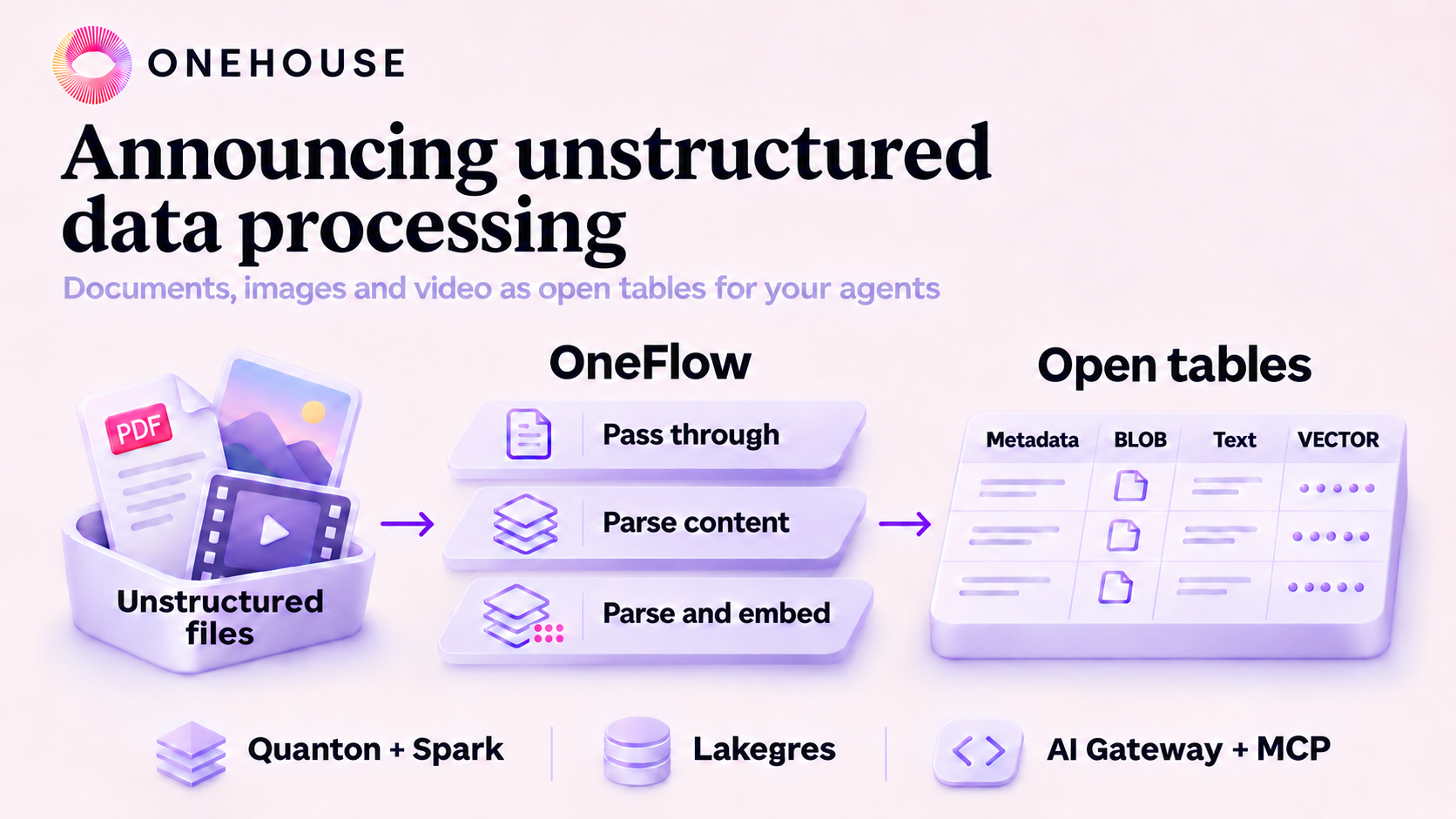
Talk with our engineers by joining the new Onehouse community Slack!
AI Data Layer
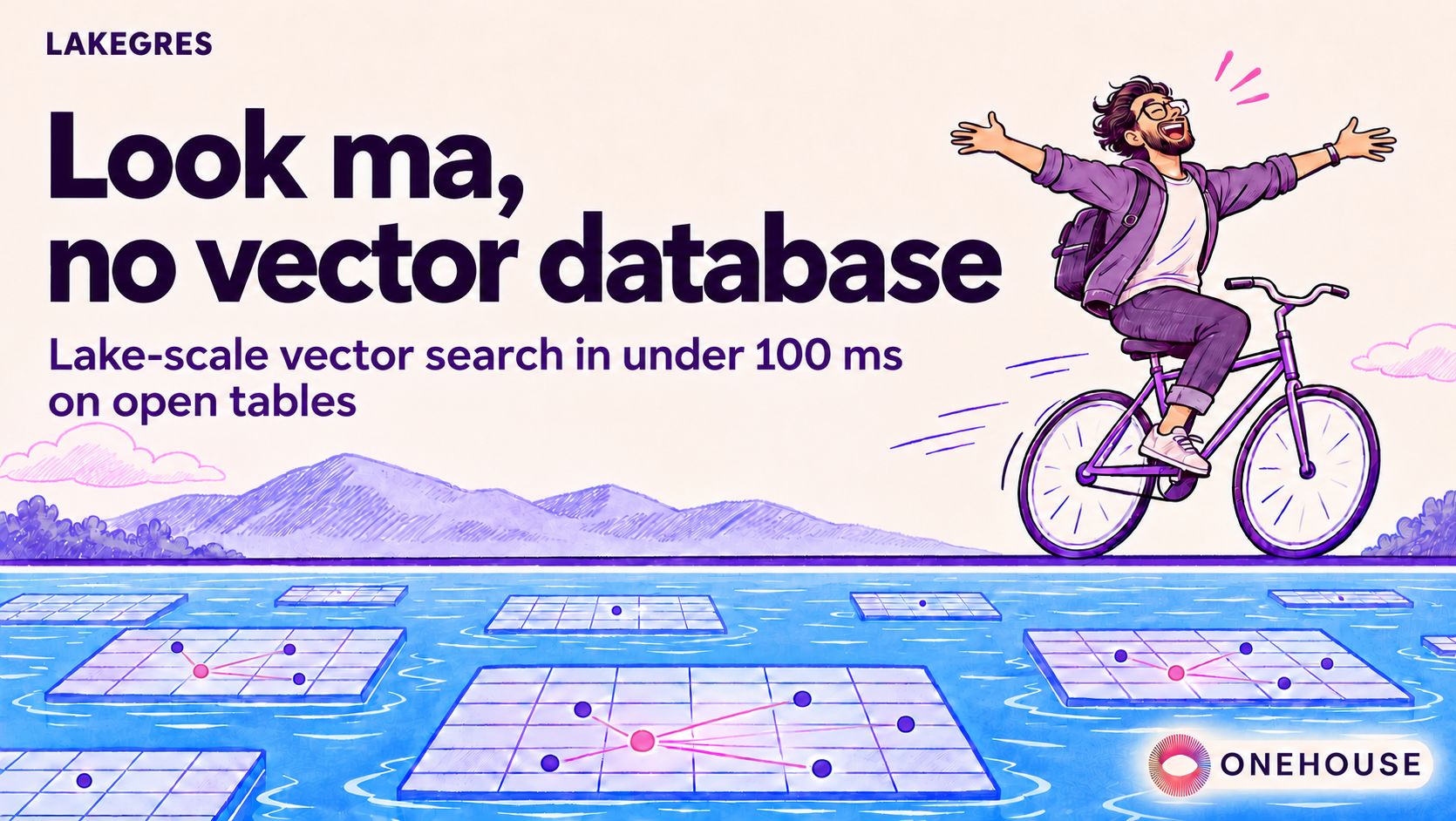
Vector search on one billion vectors in under 100 ms, served from the open tables in your lake. Agents reach lake data without a separate vector database or a search cluster loaded with vectors.

Vectors live in the same tables as the facts. One query ranks by similarity, filters and joins to business data.

There is no vector database or search cluster to load, secure and reconcile with the lake, and no second copy to rebuild when an embedding model changes.

The commits that insert, update or delete rows also update the index. You build or drop it without rewriting the table's data files.

Lakegres uses the full-text index to read only the files and rows that contain the terms. The work a query does follows the number of matching rows.

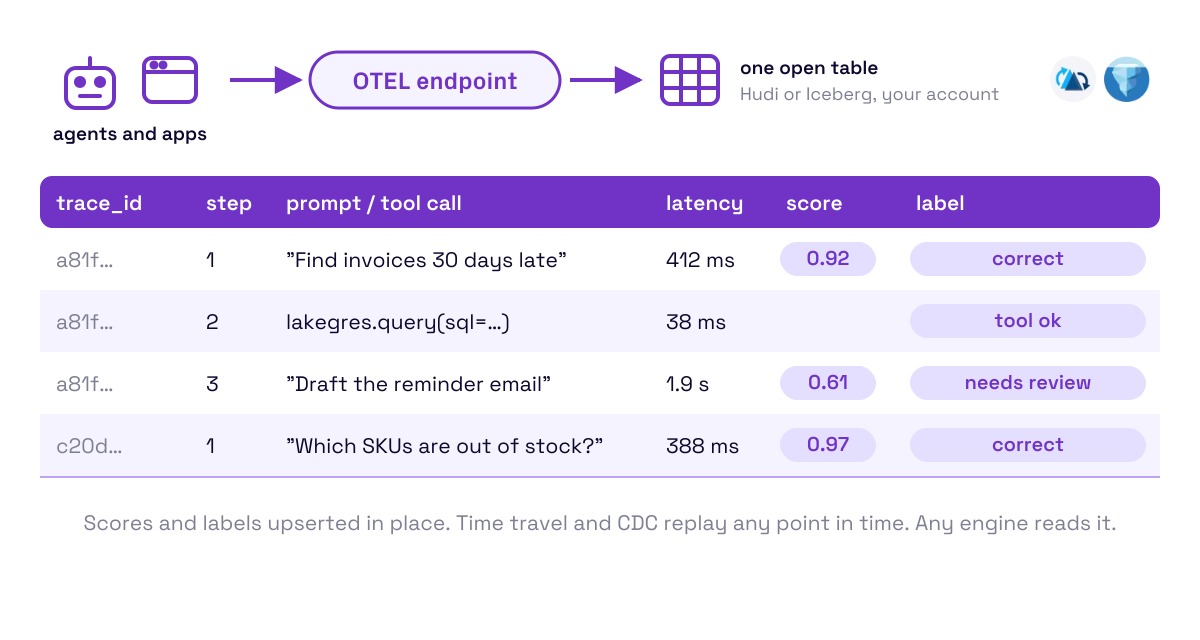
Traces the AI Gateway records and text parsed from documents, images and video are tables too, so the same search covers them.

Point-in-time queries apply to all tables, so evaluations and RL rollouts read the lake as of a past moment.
79 ms
median warm query for the 10 nearest neighbors on one billion 768-dimension vectors, against 582 ms on Databricks AI Search
0.927
recall@10 on the same one-billion-vector benchmark, against 0.860 on Databricks AI Search
30 min
to build the index in a separate build benchmark, against over 4 hours on Databricks AI Search
0.78 s
median text search query on the MS MARCO passage corpus, down from 6.4 s without the index
Caller
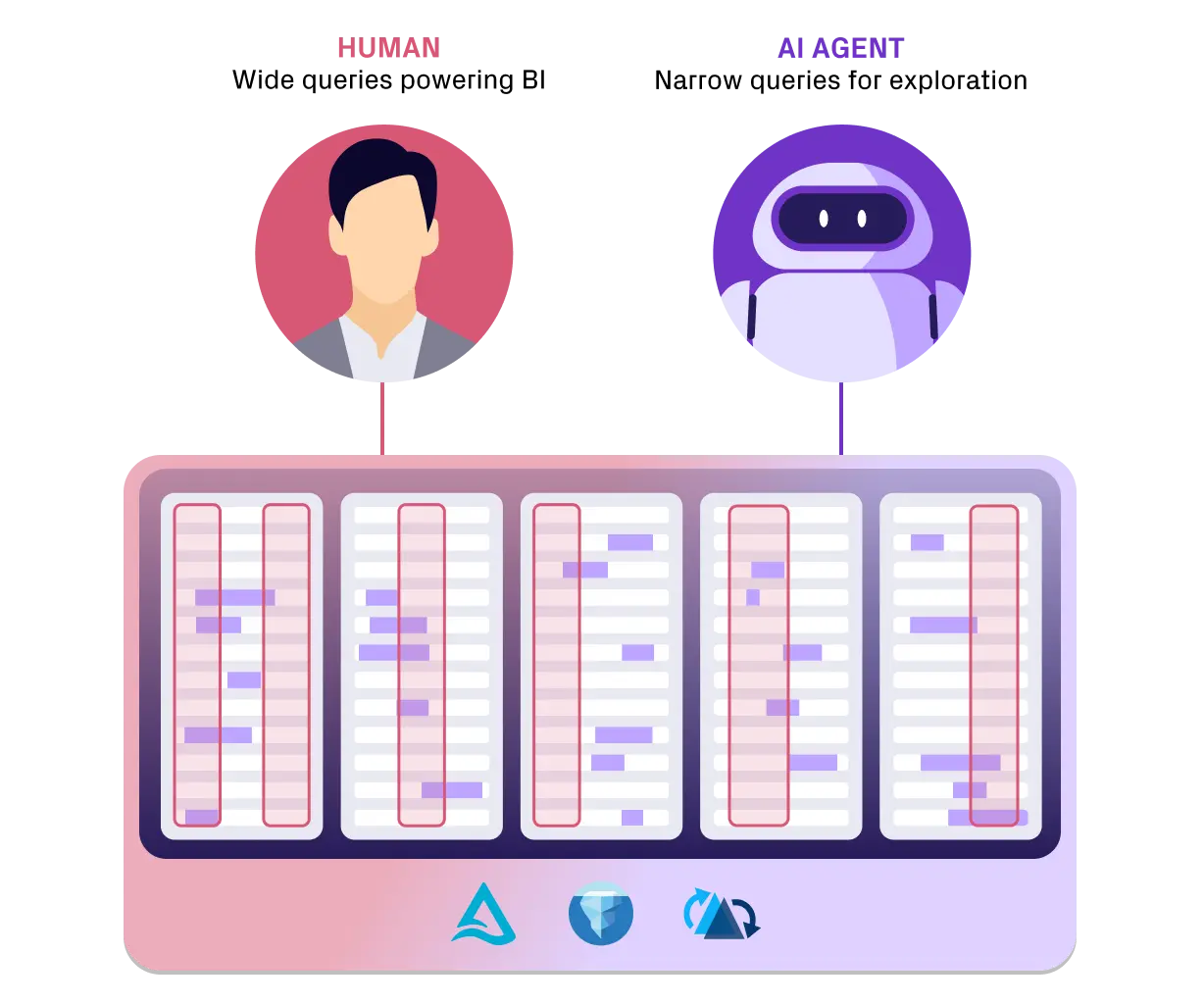
AI agentsAsk by meaning, by words, by key and in aggregate, within one taskOnehouse
Four query shapes
 Text searchWords and phrases, from the full-text index
 Point lookupsRecord and secondary indexes
 Analytical queriesRollups and joins. The one shape the lake already served.
Lakegres stores the vector index and the full-text index in the table's metadata. A search is a SQL statement on the same tables that serve analytics and lookups, so its results can be filtered and joined in that statement.
Full vectors stay in the table. The index holds compact quantized codes grouped into clusters. A query narrows the candidates from those codes before it fetches full vectors, so the dataset does not need to fit in memory.
Any Postgres client. Agent frameworks, DBeaver, Tableau, Power BI and Looker connect over the PostgreSQL wire protocol.
Governed on every query. Table and row policies from the governance catalog apply to each search.
A CREATE INDEX statement builds the vector index on an existing Hudi or Iceberg table, without rewriting its data files. Any Postgres client then calls vector_search to get the nearest rows and their distances.
Latency against recall. The nprobes option sets how many clusters a query opens, which is the main tradeoff between latency and recall.
Built on elastic compute. The index is built on the lakehouse's compute, so a larger cluster builds it faster.
CREATE INDEX embedding_idx ON fineweb_documents
USING VECTOR (dense_embedding)
OPTIONS (
  `vector.metric` = 'l2',
  `vector.num_clusters` = '65536',
  `vector.rabitq.bits` = '4'
);

SELECT id, _distance
FROM vector_search(
  'fineweb_documents', 'dense_embedding',
  ARRAY[0.12, -0.03, 0.44],   -- the query embedding, shortened here
  10, 'l2', 'ivf_rabitq_mdt',
  'vector.query.nprobes=256'
);
Agents search the traces the AI Gateway records to find how a similar task went. They also search the text extracted from documents, images and video, then fetch the original from the same table.
Vectors next to the records. Embeddings are columns of the table they describe. Flows generate them at ingest, for the files that are new since the last run.
No. Lakegres, the Postgres-compatible SQL engine in Onehouse, keeps a vector index in the metadata of the open table, in the same bucket as the data files, and searches it from the endpoint that already serves your analytics. The full vectors remain a column of the table. Nothing is copied into a vector database or a search cluster, so there is no sync pipeline to operate between the lake and a second system.
Vector search works on existing and new Apache Hudi and Apache Iceberg tables. A CREATE INDEX statement builds the index on a table that has a vector column and leaves the table's data files unchanged. You can rebuild the index with different settings or drop it later, and analytical queries on the table keep working throughout. Iceberg support builds on the Hudi-backed indexing work in Apache XTable (Incubating).
On one billion 768-dimension vectors, warm Lakegres queries for the 10 nearest neighbors returned in 79 ms at the median and 114 ms at p99, with recall@10 of 0.927. The table was a 1-billion-row subset of the public FineWeb-10B dataset, about 4.6 TB compressed on Amazon S3, and 200 queries ran one at a time on 20 executor nodes with nprobes set to 256. The storage-optimized tier of Databricks AI Search took 582 ms at the median with recall@10 of 0.860 on the same workload. Lakegres times were measured at the client and Databricks times at the server. The benchmark post has the full setup.
Each commit that inserts, updates or deletes rows also writes a small update to the index, so no separate sync job runs. When a vector changes, the writer marks its old index entry as deleted and adds a new one, and compaction periodically merges these updates into the index. Before a search, Lakegres checks the table's commit history to confirm that the index covers the snapshot being queried. A stale index cannot serve the query. Depending on the configuration, the query returns an error or scans the table for exact results.
Yes. vector_search is a table function called inside a SQL statement, so the same statement can filter the nearest rows it returns and join them to business tables. The embeddings are a column of the table that holds the facts, which means the join needs no second system. Inside the nearest-neighbor search itself, the first release filters through partition pruning, as the launch post describes.
Yes. Lakegres maintains a full-text index with the table and uses it to find words and phrases, so a query reads only the files and rows that contain its terms. On the MS MARCO passage corpus, the index cut the median query time from 6.4 s to 0.78 s. At 884 million passages, which is 100 copies of that corpus, a warm query that matched 11.5 million rows returned in about 1.3 seconds. The platform guide covers text search.
Every search runs under the table and row policies of the Onehouse governance catalog, the same policies that apply to dashboards and other SQL on Lakegres. Users sign in with OAuth through identity providers such as Okta, Microsoft Entra and Google. Agents that connect through the AI Gateway reach Lakegres through the gateway's built-in MCP (Model Context Protocol) server, so those policies also apply to their tool calls.
Every vector database next to the lake is another copy to load and secure, and to rebuild each time the embedding model changes. Build the index on a table you already have, and run your first search from any Postgres client.