Talk with our engineers by joining the new Onehouse community Slack!
AI Data Layer
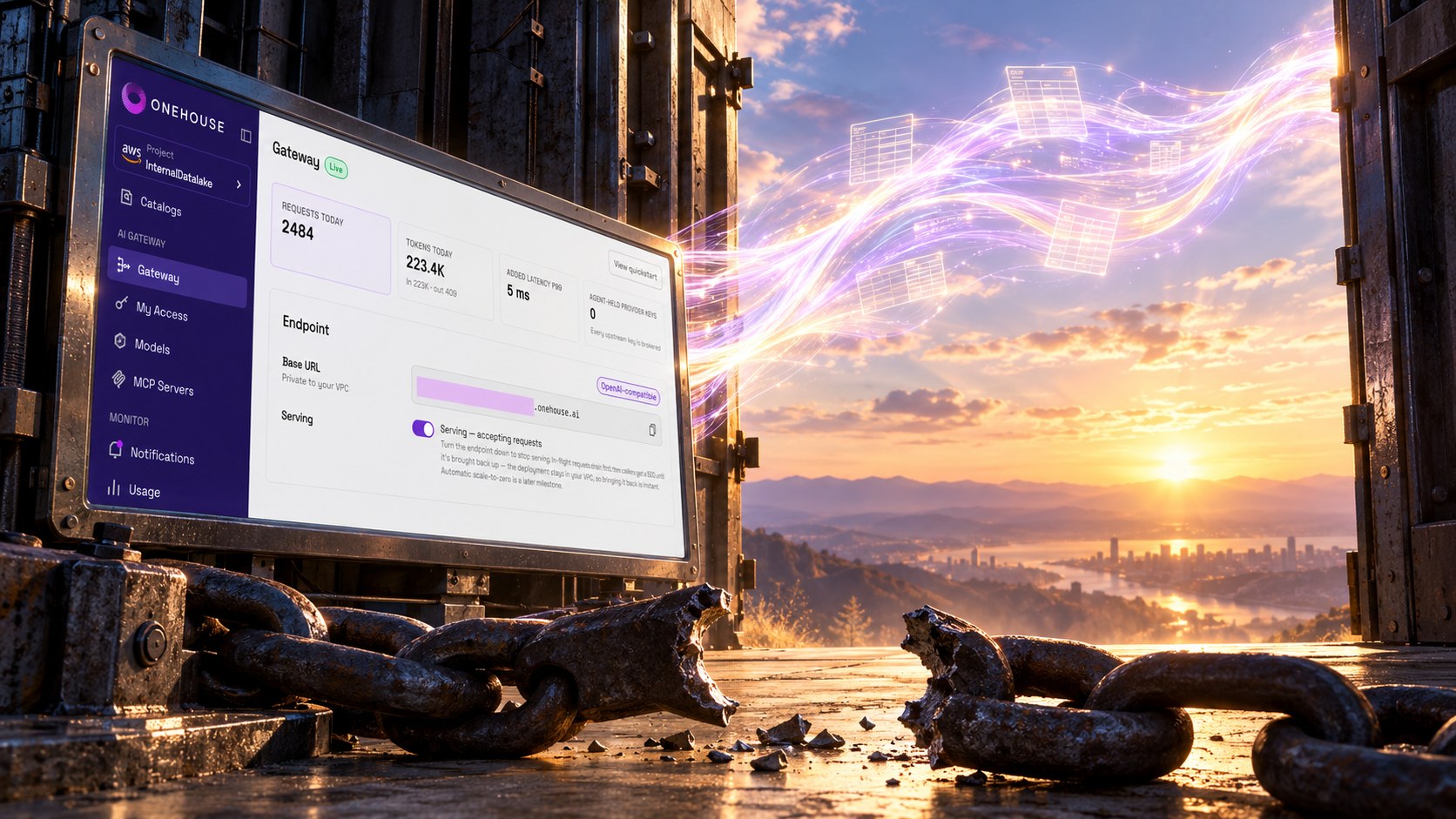
Every agent run leaves a trace of its model calls, tool calls and results, and those traces are gold for evals and training. AI Gateway is the central place to govern every call and capture every trace, at more than 1 GB/s of trace data into open Iceberg tables on four CPU cores.

Agents point at an alias once. Change the model behind it, add fallbacks or split traffic without touching agent code.

You decide which groups can call which tools. The gateway brokers credentials, so no agent holds a provider key.

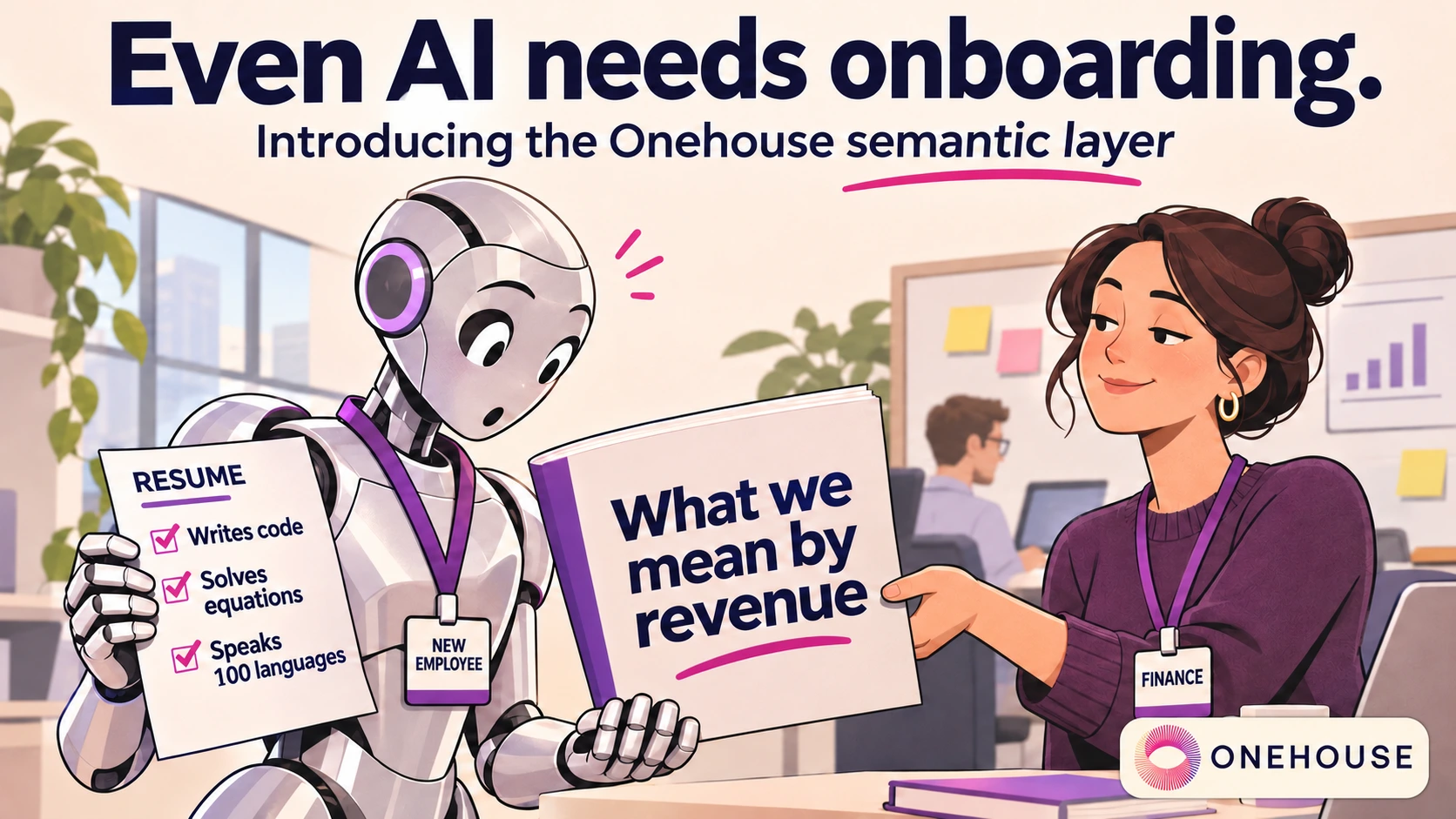
The built-in MCP server exposes every table through Lakegres, the Postgres-compatible SQL engine in Onehouse, with the governance policies already set on those tables.

Inference activity, latency and estimated spend land in tables you query with SQL.

Traces stay mutable and versioned. Human reviewers or model judges attach scores and labels after a run, and evals read the table as of any point in time.

You keep direct relationships and bills with your inference providers.
1.08 GB/s
of uncompressed trace data written to Iceberg tables on S3 by one 4-vCPU instance. That is about 93 TB a day.
343,000
spans per second in the same test, replaying agent sessions from public datasets. A span is one step of an agent run, such as a model call or a tool call.
$172
a month in AWS on-demand compute for one 4-vCPU instance, enough to log a 100 MB/s trace stream. Databricks Unity Gateway's $0.10/GB fee for logging inference requests comes to $26,280 a month on the same stream.
Your agents
Agents and appsCoding agents like Claude Code and Codex, copilots and analytics assistantsOnehouse
Routed to
 Any model providerThe model you choose for each callOther MCP toolsAuthorized per user and tool
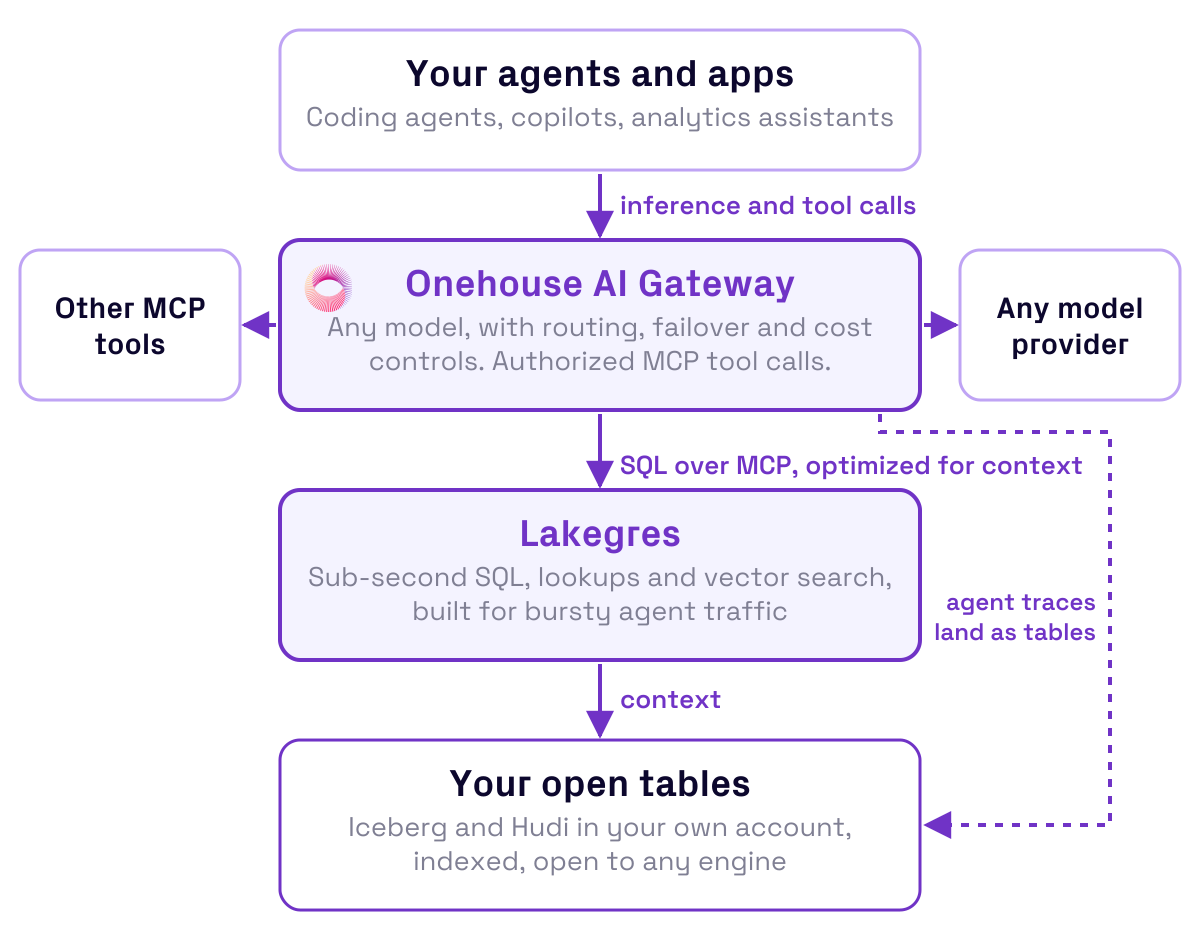
AI Gateway sits between your agents and everything they call. Inference goes to the model providers you configure, and tool calls go to MCP servers under central access control.
Access per model. You set which users and groups may call each model, and see all activity against it on the model's page.
One MCP endpoint for agents. Register MCP servers for documents, wikis, GitHub or ticketing systems next to the built-in one. An agent connects once and sees every server's tools, each under its own namespace.
Metrics and embeddings too. Agents search and query certified metrics through two gateway tools, and OneFlow ingestion flows call embedding models through a gateway alias.
For Claude Code, connecting takes a gateway token and three environment variables. From then on, every call it makes is routed, checked against tool permissions and recorded.
read -rs ONEHOUSE_GATEWAY_TOKEN && export ONEHOUSE_GATEWAY_TOKEN
export ANTHROPIC_BASE_URL="<gateway url>"
export ANTHROPIC_CUSTOM_HEADERS="X-Onehouse-Authorization: Bearer $ONEHOUSE_GATEWAY_TOKEN"
export ENABLE_TOOL_SEARCH=true
claude
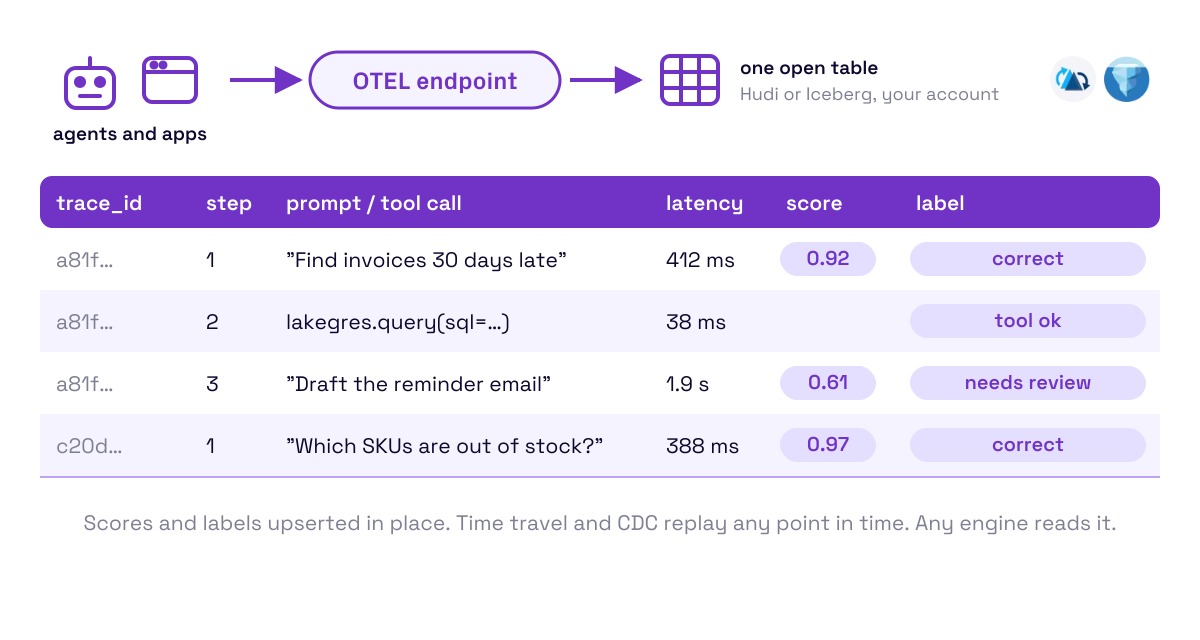
Every routed call is recorded, linked to the agent run it belongs to, and written to an Iceberg table on your object storage.
Other traces too. Traces that agents send over OpenTelemetry or from the Langfuse SDK land in the same tables, whether or not their calls go through the gateway.
Queried like any table. Read them with time-travel, incremental or CDC queries.
Input to training. Traces feed evals, reinforcement learning environments and post-training datasets.
An AI gateway is a shared entry point between AI agents and the models and tools they call. It handles model routing, authentication, access control and observability in one place, so each agent does not need its own integration with every provider. Onehouse AI Gateway combines an inference gateway for model requests with an MCP (Model Context Protocol) gateway for tool calls, and it records the calls it routes in open tables in your account.
AI Gateway supports Anthropic, OpenAI, Amazon Bedrock and Baseten, each added with your own credentials. You publish models behind stable aliases. For each model you choose the fallback models to use when it is unavailable, or a traffic split that sends a share of requests to another model. Agents keep calling the same alias when the model behind it changes, and you keep your direct contract and bill with each provider.
No. Onehouse adds no charge on the token volume routed through AI Gateway. The gateway calls each provider with your own credentials, so your provider relationships and bills stay direct. Beyond that, you pay only for the infrastructure the gateway runs on in your own account.
AI Gateway runs on Kubernetes in your own account, inside your network. It deploys on AWS, Google Cloud, Azure, on-premises and NeoClouds. Traces are written to your object storage as open Apache Iceberg tables, so you set their retention, including keeping them indefinitely. Inference activity, latency and estimated spend by caller and model are also stored in open formats on infrastructure you control.
MCP (Model Context Protocol) is the protocol agents use to reach tools and data, and an MCP server is a service that exposes tools to them. AI Gateway presents the MCP servers you register, together with its built-in server for SQL on your tables, to an agent as one server. You decide which groups may call which tools on each server, and each tool call passes through the gateway, which applies those permissions. The gateway holds the servers' credentials, so agents never do. Governance covers model and tool permissions together.
You connect Claude Code by exporting a gateway token and three environment variables before you start it. ANTHROPIC_BASE_URL points at the gateway URL, ANTHROPIC_CUSTOM_HEADERS carries the token in an X-Onehouse-Authorization header, and ENABLE_TOOL_SEARCH is set to true. The token comes from the gateway token page. Other coding agents such as Codex also connect with a token and a few environment variables. The platform guide lists the commands.
Agent traces record the model calls and tool calls of each agent run, and teams use them as input to evals, reinforcement learning environments and post-training datasets. A human reviewer or a model judge can attach scores and labels to a run after it finishes, and every version of the trace is kept. Evaluation suites read the trace tables with time-travel, incremental and CDC queries. Platform teams also query them with SQL to see activity, latency and estimated spend by caller and model.
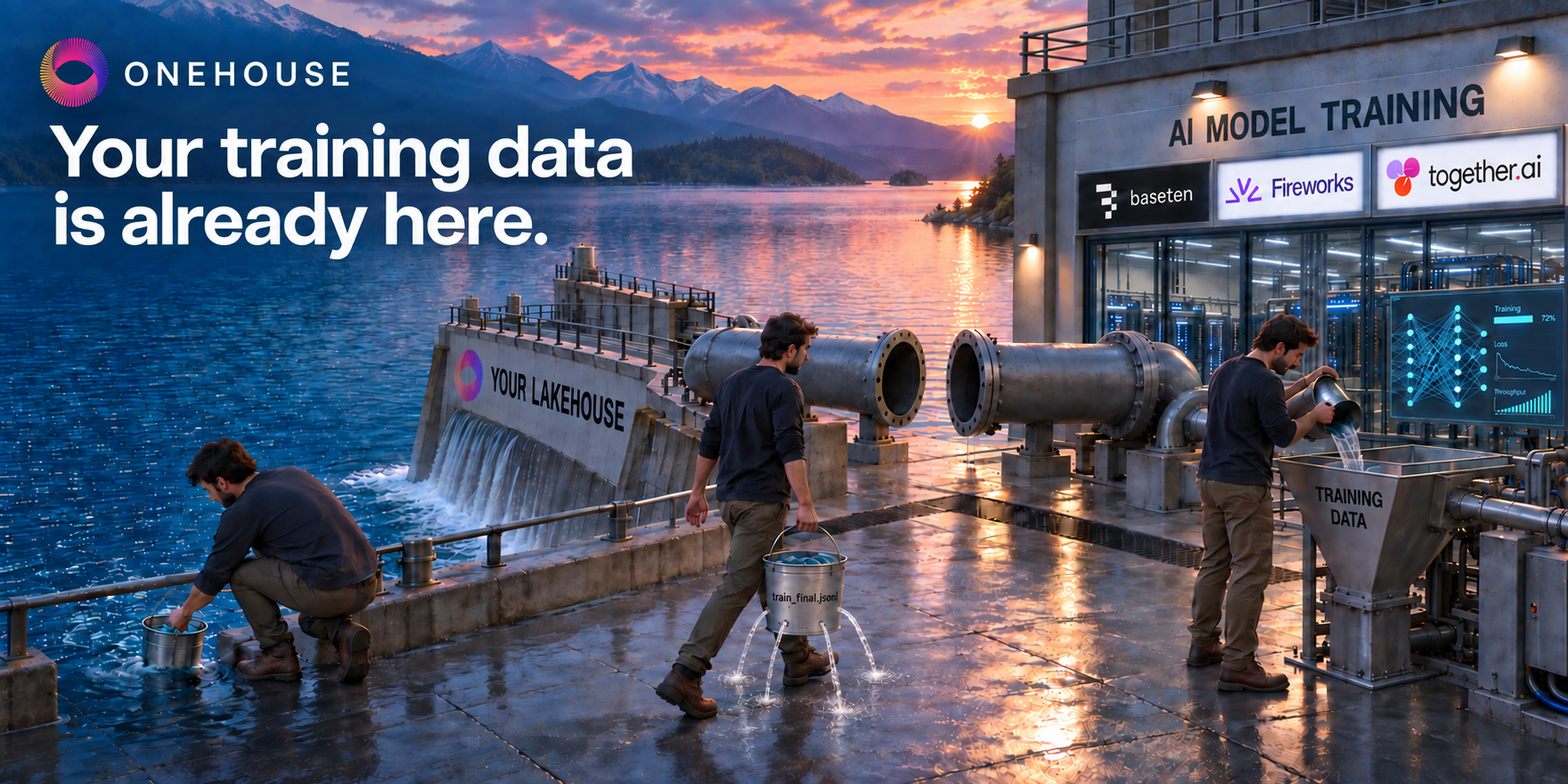
An agent call that is not recorded today cannot be scored or used as training data later. Put AI Gateway in front of one agent, and its model calls, tool calls and traces land in tables you query with SQL.