Talk with our engineers by joining the new Onehouse community Slack!
Core Lakehouse Services
Dashboards, models and agents are only as current as the tables they read. OneFlow ingests database CDC, event streams and files into open tables, with changes queryable in as little as 10 to 15 seconds.
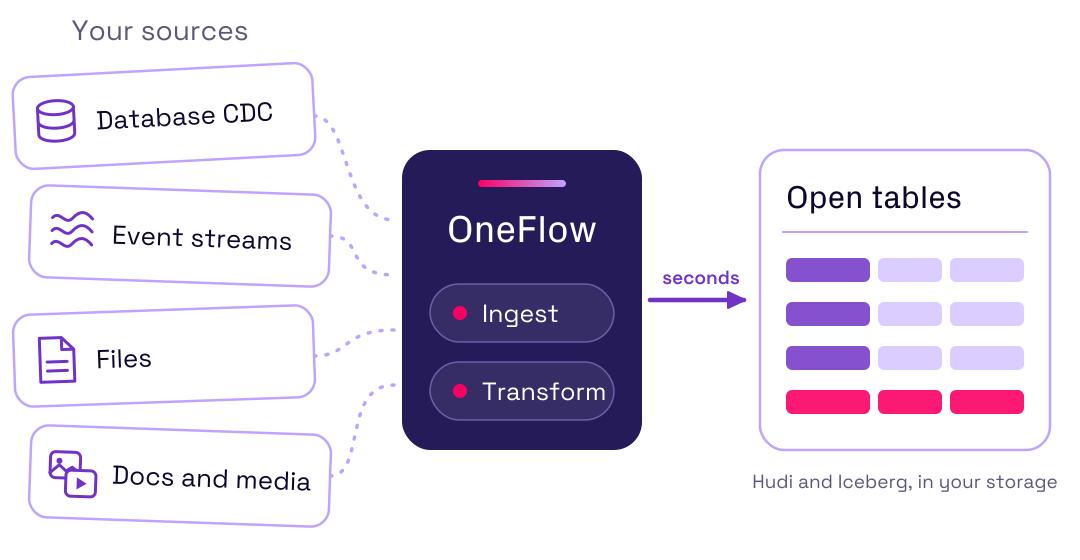

Each pipeline is called a Flow. Onehouse handles its orchestration, scaling, checkpoints, retries and alerts, so your team does not operate ingestion jobs.

A Flow uses compute only during a sync: between syncs a lightweight poller checks the source for new data, and a sync with nothing new is skipped. The Onehouse Compute Runtime adds and removes capacity as load changes, so a burst of source data needs no cluster resizing from you.

A Flow can read the table another Flow writes, so you chain Flows into a pipeline and add transformations at each step. Each one processes only the records that changed since its last sync, so cost follows the volume of new data as tables grow.

OneFlow is the only managed ingestion service that runs compaction and other table maintenance on open tables without blocking the writer or taking it offline. High-volume CDC and streaming writers keep going while maintenance runs.

The source checkpoint commits atomically with the data, so a restarted Flow resumes where it stopped without duplicating or dropping records. An ordering field decides which version of a record wins when events arrive late or are replayed.

Each sync registers the table in the catalogs you choose, such as AWS Glue, Unity Catalog and Snowflake. Every engine reads one copy of the data in your buckets.
10 to 15 s
best-case delay from a source committing a change to the change being queryable, on event streams and database CDC at petabyte scale
350 TB+
of CDC data that a single customer ingests through OneFlow every day
557B
records in a single table that OneFlow keeps replicated, at a collaboration platform
Sources
 Database CDCInserts, updates and deletes
 Event streamsKafka-compatible topics and Kinesis
 FilesStructured files in object storage
OneFlow
Open table
Hudi or Iceberg tableOne copy, in your own object storage

Query
Any engineSpark, Trino, Snowflake, Databricks and othersA Flow reads from an operational database, an event stream, a storage bucket or another lakehouse table and keeps one target table current. Tools such as Airbyte that write to Kafka or object storage extend the list, because OneFlow picks the data up from there.
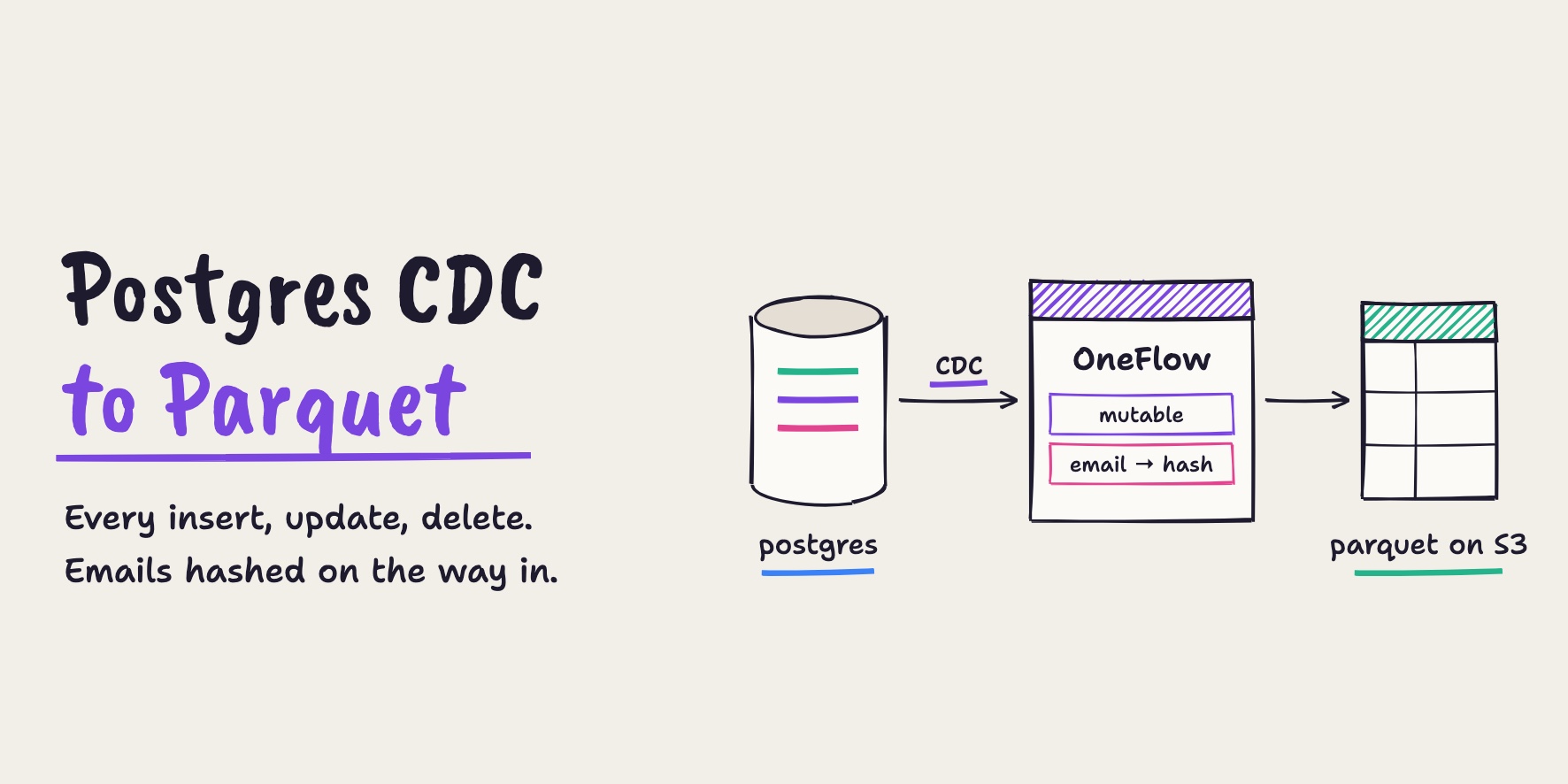
Database change data capture. Every insert, update and delete in the source database is merged into the target table. On Azure, OneFlow captures changes from Azure Database for PostgreSQL.
Event streams. Azure Event Hubs is read through its Kafka endpoint, like any other Kafka-compatible stream. One Flow can read a topic spread across several Kafka clusters into one table.
Files on cloud storage. A Flow watches a bucket and ingests Avro, CSV, JSON, Parquet, Proto and XML files. LakeLog lands database change events on your object storage over a Kafka-compatible REST API, so CDC needs no Kafka cluster.
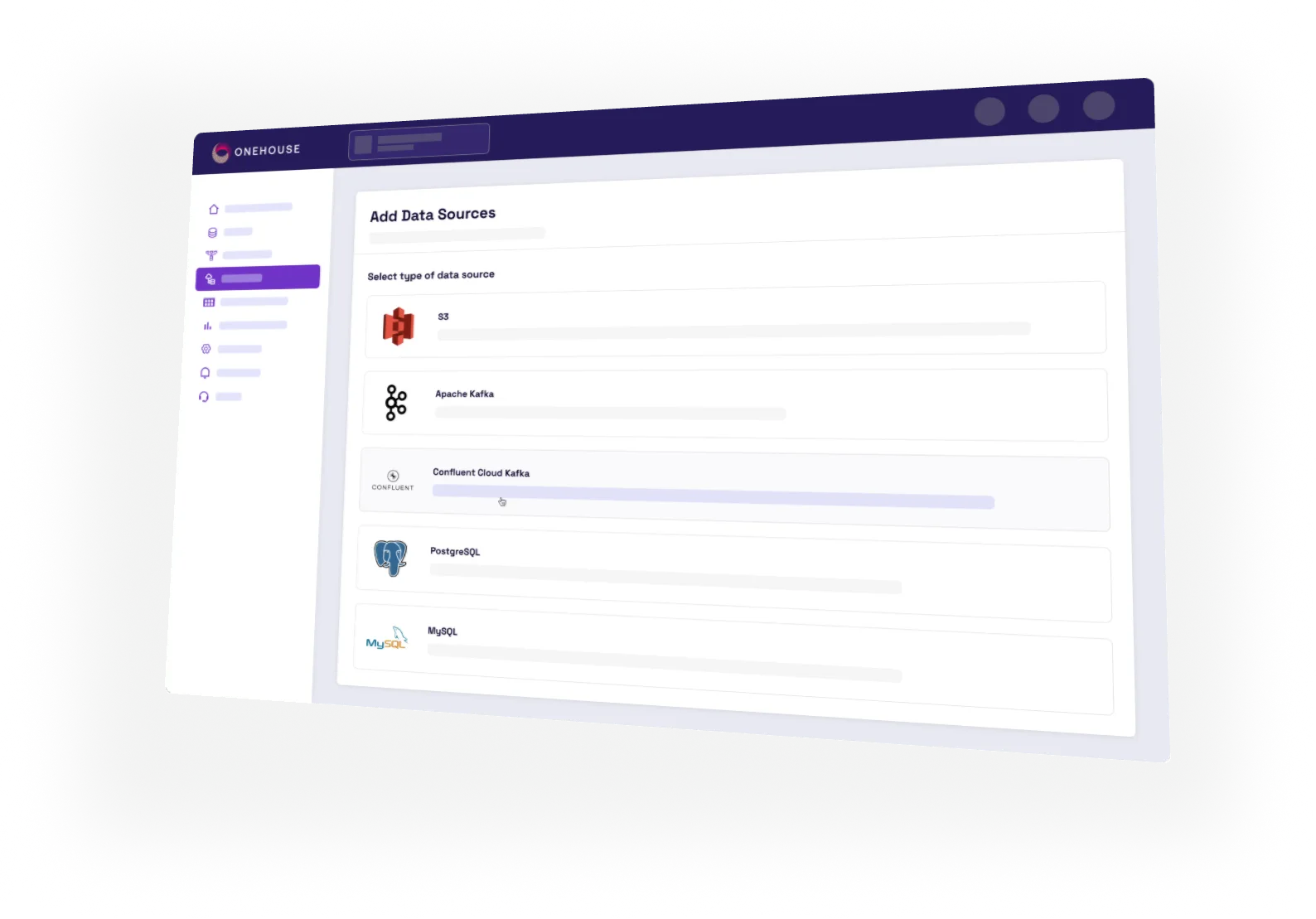
A Flow reads a table already in your lakehouse the same way it reads Kafka or a database, so one Flow can consume what another writes. Each Flow reads only the records that changed upstream, through the table's change stream, and checkpoints its own progress.
No orchestrator to keep stages in order. Each Flow resumes where it stopped, so the chain needs no Spark job to write or tune and no scheduler to sequence it. The whole chain stays minutes fresh.
Transformations at every step. Each Flow applies its own transformations and validations as records land, and they run only over the records that changed in that sync.
Five choices define a Flow. Pick the source, the target table and its keys, the transformations and validations, the catalogs to sync, and the cluster and sync frequency, in the console or through the API.
In a medallion architecture, raw data lands in bronze tables and cleaned data in silver. One set of Flows lands each source as a bronze table, and a second set reads bronze and writes silver, using built-in transformations you select in the console.
Built-in transformations. Convert Debezium CDC events to row-level changes, flatten structs, explode arrays, parse JSON, filter rows and columns, derive columns, mask sensitive fields and generate vector embeddings.
Your own code when you need it. Custom transformations run your DataFrame code from a managed JAR, inside your VPC. Apna keeps history in its silver tables this way, with no Spark jobs.
Gold on Quanton. Joins across many tables and aggregations for a gold layer run as Spark jobs or SQL pipelines on Quanton, which read the same change streams.
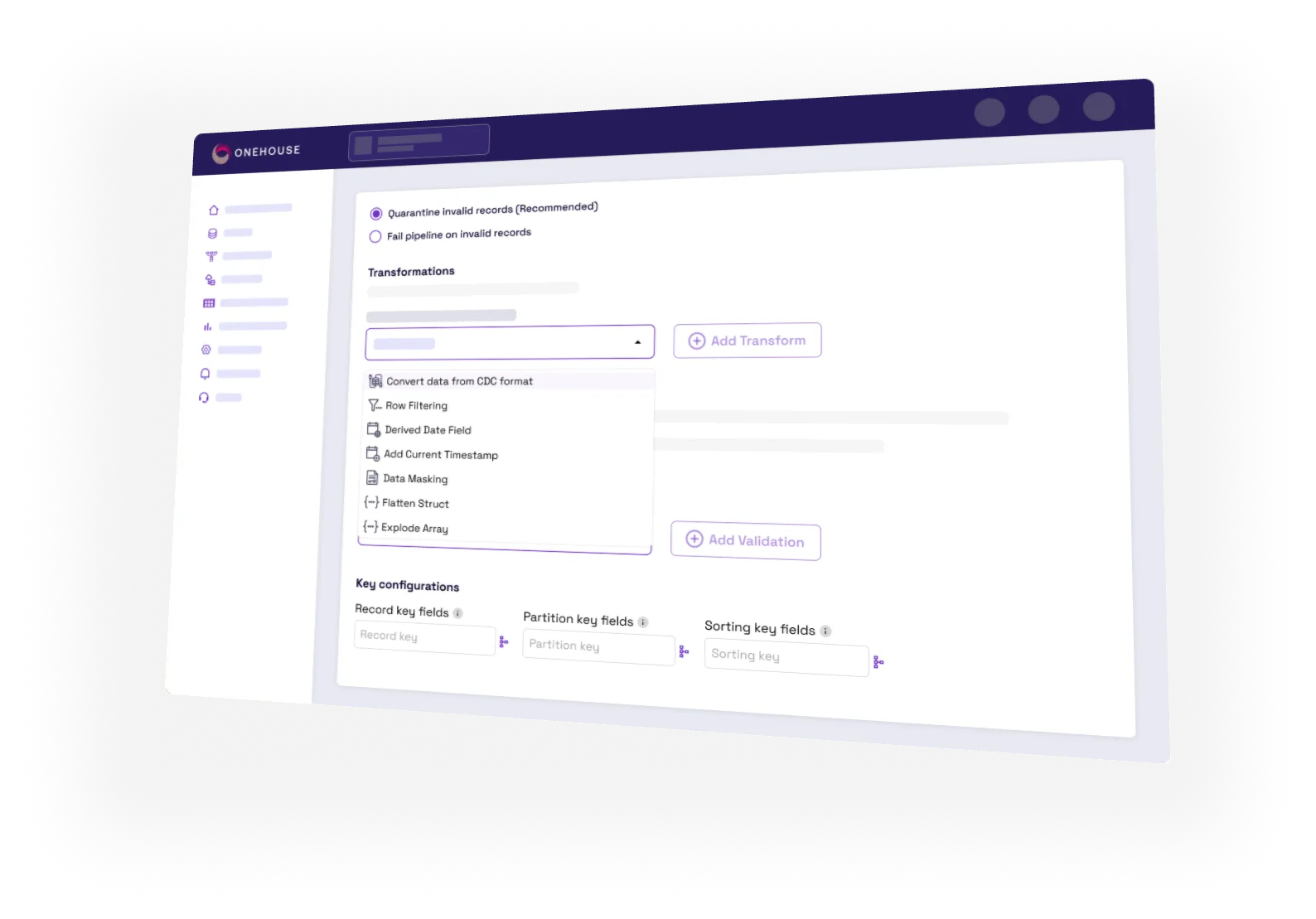
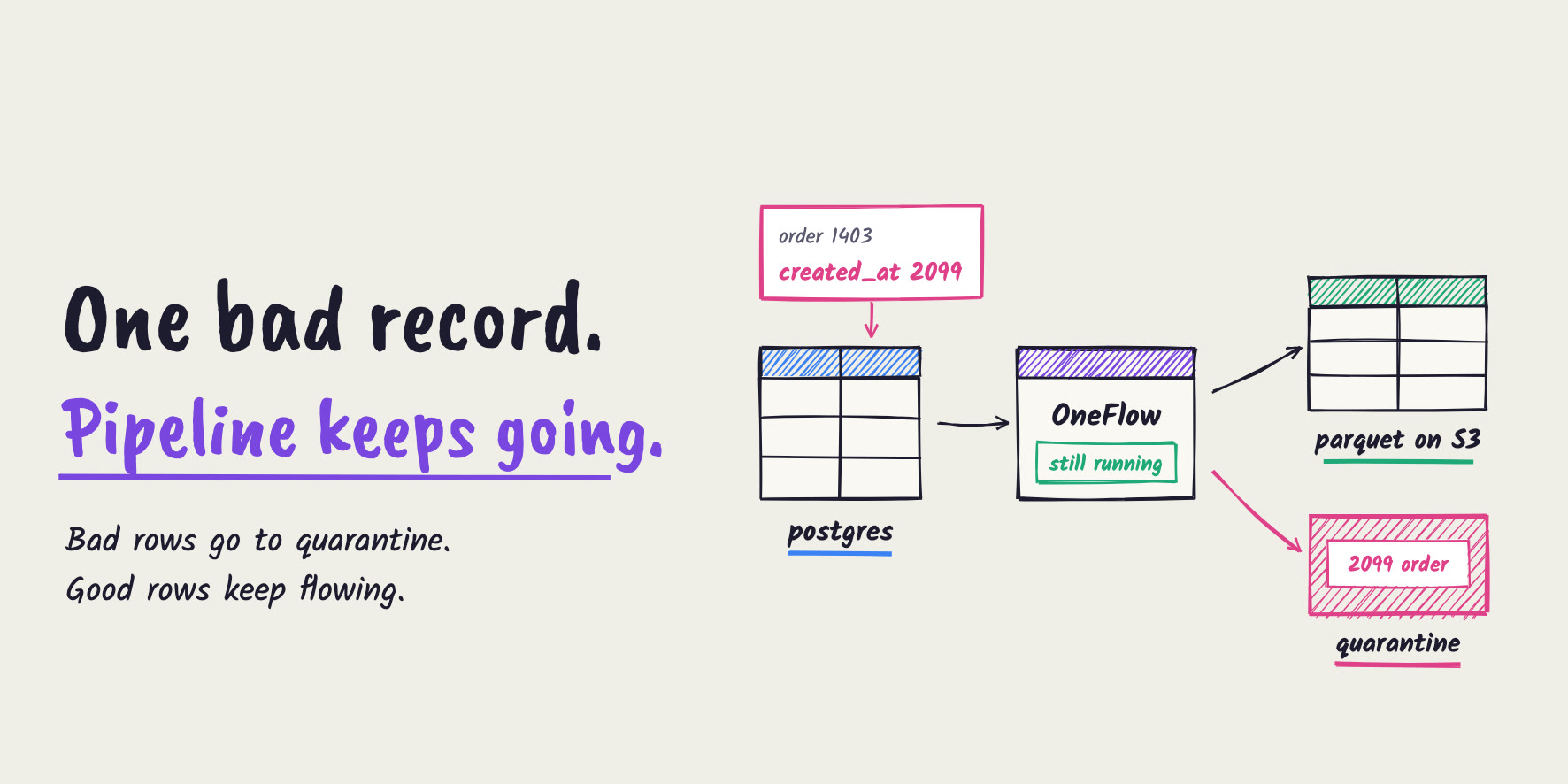
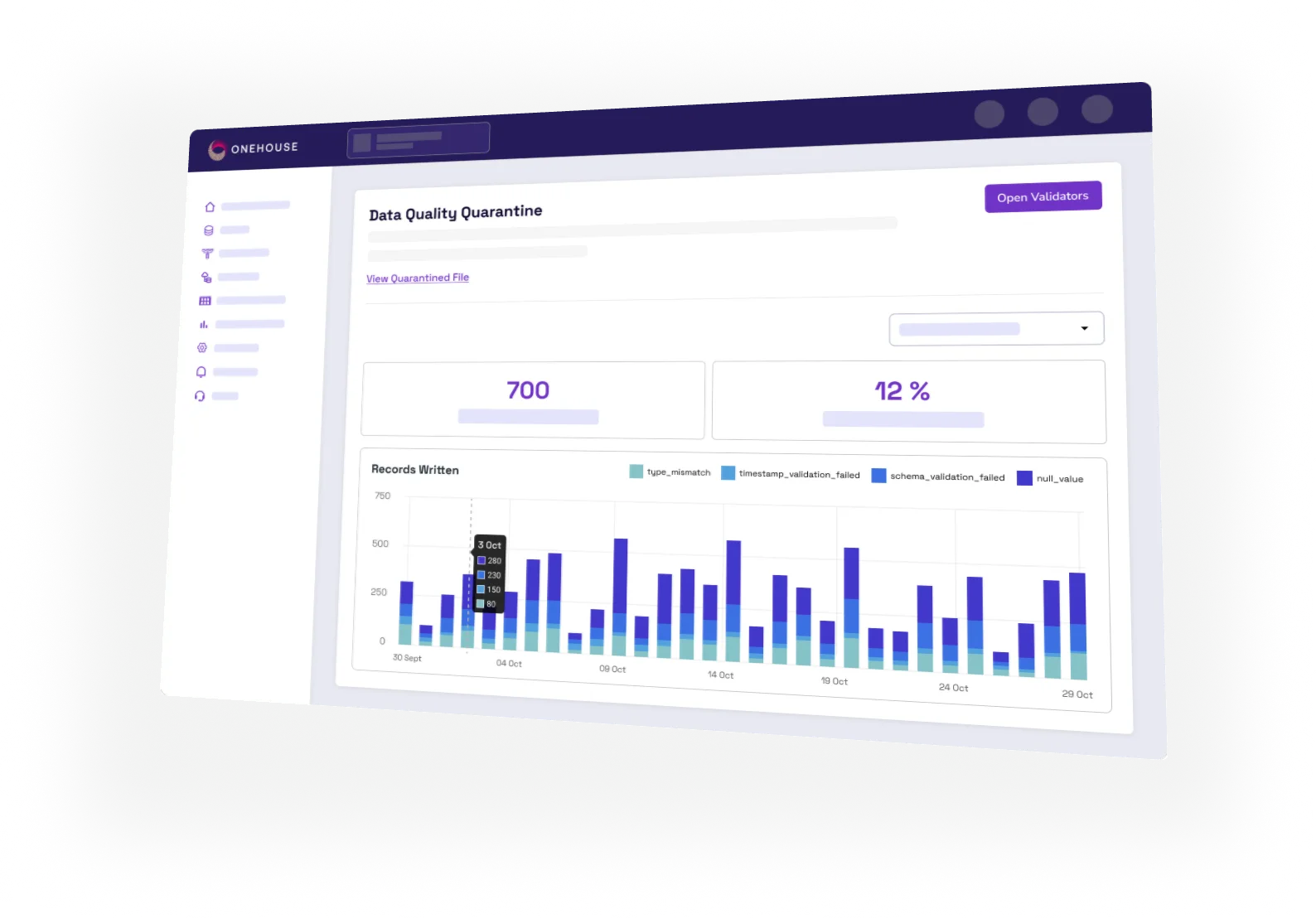
Validations check each record's schema or timestamp format before it reaches the table. You choose what a failing record does: it goes to a quarantine table beside the target, annotated with the reason it was rejected, or it fails the pipeline. You query the quarantine table like any other.
Automated schema evolution. New nullable columns are added, dropped columns are retired with existing rows retained, and column types widen along Int, Long, Float, Double and String. Backward-compatible upstream changes do not stop the Flow.
Auto data discovery. A directory of many tables in object storage can be ingested in one pass, either bootstrapping existing files or starting from new arrivals only.
Savepoints and restore. A savepoint bookmarks a table at a point in time, and a service can take them on a schedule. Restoring one returns the table to a known-good state after a bad batch or an upstream bug.
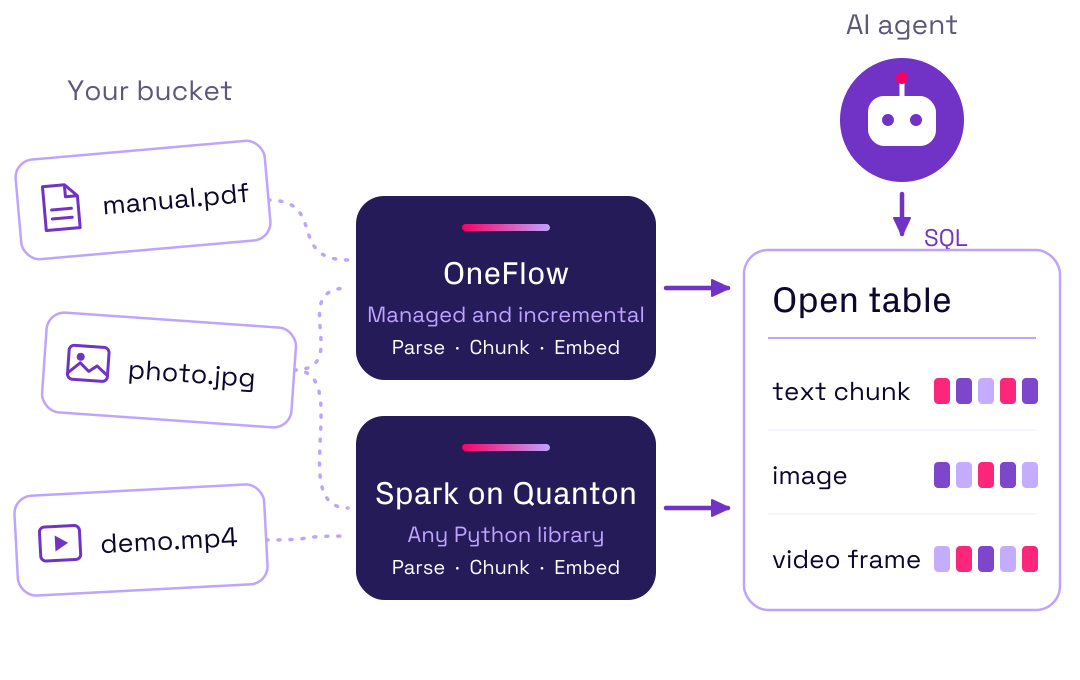
OneFlow also ingests unstructured data. A Flow watches a bucket of PDFs, images and video, parses and chunks each new file, and can embed it, so the content lands as rows in an open table that agents query in SQL.
Same incremental model. Each run processes only the files that are new since the last one. The unstructured data page covers the processing options and benchmarks.
600+
production pipelines migrated to Onehouse. OneFlow replaced the custom Spark streaming jobs that ingested raw Kafka transaction events into Hudi tables.
50M+
users on a job platform that lands Postgres and MongoDB CDC and clickstream events as bronze tables and builds its silver layer with Flows, with no Spark jobs
< 3 min
to issue an insurance quote and certificate, a process that used to take days or weeks, on a lakehouse with managed CDC ingestion and data fresh in minutes
3+ h to < 15 min
batch processing time after replacing self-managed Spark jobs with the managed service, with about 40% lower infrastructure cost and one engineer operating the platform
OneFlow ingests database change data capture (CDC), event streams and files. CDC covers Postgres, MySQL, Oracle, SQL Server, MongoDB and other databases supported by Debezium, the open-source change capture connector. Event streams are Apache Kafka, Confluent, Amazon MSK, Amazon Kinesis, Redpanda, Apache Pulsar and other Kafka-compatible streams. File sources are Amazon S3 and Google Cloud Storage, including documents, PDFs, images and video. A Flow, which is one OneFlow pipeline, can also read a table already in your lakehouse.
On event streams and database CDC, a change is queryable in as little as 10 to 15 seconds after the source commits it. That figure is the best case, and you choose how often each Flow, which is one OneFlow pipeline, syncs. Flows write merge-on-read tables by default, where changes are logged and compacted later, so updates land quickly.
No. LakeLog lands database change events on your object storage as an open table, so CDC needs no Kafka cluster. Producers write change events to LakeLog over HTTP, with the same producer API as the Confluent REST Proxy, and each Flow reads whatever has landed since its last read. If you already run a Kafka-compatible stream, OneFlow reads Debezium change events from it. The data ingestion guide lists what each database source needs.
OneFlow is a managed service, so Onehouse operates the pipeline that your team would build from a Kafka cluster, a Debezium connector, a schema registry and a Spark job. Onehouse handles orchestration, scaling, checkpoints, retries and alerts for each pipeline, and a built-in transformation converts Debezium CDC events to row-level changes. Compaction and other table maintenance run without blocking the writer.
Yes. A Flow, which is one OneFlow pipeline, can read the table another Flow writes, so you chain Flows into a multi-stage pipeline. One set of Flows lands each source as a bronze table, and a second set reads bronze and writes silver with built-in transformations and no code. Each Flow reads only the records that changed upstream and checkpoints its own progress, so the chain needs no scheduler to sequence it.
Yes. OneFlow writes Apache Hudi and Apache Iceberg tables in your own storage, and each sync registers the table in the catalogs you choose, such as AWS Glue, Unity Catalog and Snowflake. OneSync, the catalog sync service, and Apache XTable (Incubating), which translates table metadata between formats, expose the same tables as Delta Lake. Every engine reads one copy of the data in your buckets. The governance page covers catalog and permission sync.
OneFlow writes your tables to your own object storage in open formats, and the compute that reads and writes them runs in your account. The connections to the Onehouse control plane, the API and console that Onehouse hosts, carry commands, metadata, metrics and logs. Table data stays in your account. Onehouse is SOC 2 Type I and Type II certified and holds PCI DSS certification. The deployment page describes the model on AWS, Google Cloud, Azure and your own Kubernetes.
Onehouse bills for the compute its services consume, measured in Onehouse Compute Units (OCU), plus support, and large deployments can choose a flat annual fee. One OCU is four cores running for one hour. A Flow uses compute only during a sync, and a sync with nothing new is skipped. There is no fee on data volume and no storage fee, and you pay your cloud provider directly for infrastructure at your own negotiated rates. See the pricing model.
A CDC pipeline you run yourself needs someone on call for Kafka, Debezium and Spark. Connect one Postgres or MySQL database or one Kafka topic to OneFlow and compare freshness and operating effort against the pipeline you run today.